Balancing AI Regulation: A Path to Innovation

We’re at a pivotal moment. Decisions made today will shape our future with AI.

Artificial Intelligence is no longer a distant concept; it’s here, influencing everything from healthcare to finance. But with its rapid advancement comes a critical question: How do we harness its potential without unleashing unintended consequences?

Why is this crucial?

Because over-regulation could stifle innovation, preventing breakthroughs that could benefit society. Conversely, insufficient regulation might lead to ethical pitfalls, privacy breaches, and a loss of public trust in technology.

So, what’s the path forward?

A balanced approach to AI regulation.

Here’s how we can achieve it:

Inclusive Dialogue: Engage technologists, policymakers, and the public in conversations about AI’s role.

Adaptive Policies: Create flexible regulations that can evolve with technological advancements.

Ethical Frameworks: Implement guidelines that prioritize transparency, fairness, and accountability.

Investment in Education: Equip the workforce with the skills needed to thrive alongside AI.

By finding the middle ground, we can foster innovation while safeguarding societal values.

Let’s work together to shape an AI-powered future that’s both exciting and responsible.

What are your thoughts on achieving this balance?

Riding the Wave of AI Progress: The Next Big Thing in Large Language Models (LLMs)

Let’s embark on a thrilling journey as we delve into the world of advanced artificial intelligence (AI) and its extraordinary spin-off, Large Language Models (LLMs). This blog post will uncover the revolutionary trends, shedding light on how the “El Dorado” of AI innovation is influencing our lives.

Keywords: AI, LLM, Machine Learning, GPT-4, Future of AI, AI Trends, AI Innovations, NLP, Deep Learning, AI and Society, AI Breakthroughs

The Dawn of a New AI Era

Artificial Intelligence isn’t just a buzzword anymore; it’s an integral part of our everyday lives, changing the way we work, communicate, and perceive the world around us. From Siri’s morning greetings to personalized Netflix recommendations and self-driving Teslas, AI has profoundly transformed our reality.

In this era of relentless advancement, one particular AI innovation has been garnering substantial attention: Large Language Models (LLMs). The evolution from OpenAI’s GPT-1 to the groundbreaking GPT-4 architecture has been nothing short of an AI roller-coaster ride.

Demystifying LLMs: A New Level of AI Interaction

LLMs, such as the famous GPT-4, are the new rockstars of the AI world. Their ability to understand and generate human-like text is unprecedented. These models are trained on a vast corpus of internet text and can write essays, poems, summarize articles, translate languages, and even code software!

And they’re getting better. The latest LLMs have been trained to understand the context more precisely and generate more coherent and contextually relevant responses. They can even simulate multi-turn conversations, answering follow-up questions accurately.

The GPT-4 Revolution

Following its predecessors’ (GPT-3) success, GPT-4 is now changing the AI game with its increased capacity and enhanced performance. It’s like stepping into a sci-fi reality where AI can write novels, generate insightful reports, tutor in multiple subjects, and much more.

GPT-4 understands the nuances of language better than any model before it. It demonstrates improved efficiency in handling ambiguity, grasping complex sentence structures, and identifying implicit context, hence bringing us one step closer to general artificial intelligence.

The AI Impact: Society & Beyond

The influence of advanced AI and LLMs extends beyond personal assistants and content generation. It’s shaping industries, healthcare, education, and even our social dynamics. AI-powered LLMs like GPT-4 are being leveraged for mental health apps, teaching tools, customer service, and many other applications.

In this era of rapid digital transformation, mastering AI literacy will become a necessity rather than a novelty. We need to embrace AI as a tool for progress and work towards its ethical and fair usage.

AI: The Road Ahead

Despite the breakthroughs, AI and LLMs are still young in their journey. Challenges in terms of biases, security, and data privacy exist. However, the vibrant AI community continues to innovate and make strides toward creating robust and ethical AI systems.

The age of AI is here. Let’s ride the wave, one algorithm at a time. Stay tuned with us as we continue to explore the transformative world of AI and bring you the latest and most exciting AI trends and innovations.

Please share this blog post if you’ve found it insightful. It’s time to spark more conversations about the future of AI!

#AI #LLM #MachineLearning #GPT4 #FutureOfAI #AITrends #AIInnovations #NLP #DeepLearning #AIandSociety #AIBreakthroughs

Why do governments have such difficulty regulating Bitcoin and other cryptocurrencies?

The challenge for government regulatory bodies is to issue “enforceable” regulation over crypto is it needs to cover 3 main areas which are very difficult to cover without overlapping or infringing into each other. These are privacy, security, and fraud.

Photo by Pixabay on Pexels.com

For example, in order to prevent fraud, the government needs to know more about the parties involved in the transaction so they can issue regulations to allow them to persecute an individual. If they issue a regulation to reduce/protect consumers against fraud, then your privacy will get compromised – because you will stop being anonymous and therefore less secure.

On the other hand, if you want to be able to disclose some information to X but not Y, then the current security layer in place is not adequate. If you modify the current security layer in the current blockchain implementations, it could become very cumbersome for the average user to manage and/or it will require some level of centralization which goes against the idea of a fully decentralized model.

The big challenge for the regulators is how to apply governance and user protection rules to a new system without interfering with its design in such a way that it will change it into another system alltogether. For bitcoin and other cryptocurrencies to be widely accepted, some measures will need to be in place to identify and remove bad actors.

Think about it, next time your wallet (or your grandma’s crypto wallet) gets hacked and a small fortune in tokens gets removed from your vault, wouldn’t you like to be able to go to the “police” and have the police track the bad guys, arrest them and get your money back? I surely and I am pretty sure my grandma does too!

Unfortunately today no such mechanism is in place… for me, today is still a bit like the wild west, to recover your gold, you kinda have to go out and hire some skilled gunslingers (aka hacker/mercenaries) to trace the bad guys and bring you back your vault with your gold in it 🙂  

This question was originally posted in Quora, here is the link https://qr.ae/TUtF4LIf you liked my answer, go to Quora and “Upvote” it. Please share the post too, would love to hear some different points of view and comments.

Impact of AI on jobs in the future

Currently and in the future, Artificial Intelligence (A.I.) is expected to affect the way we get the news, the ads we received, the things we buy, our transportation system, the jobs we have or may not have any more, our education system, our appliances, and our health. While many of these things are great news, however, we may have to be aware and ready for a rapidly changing world and job security.

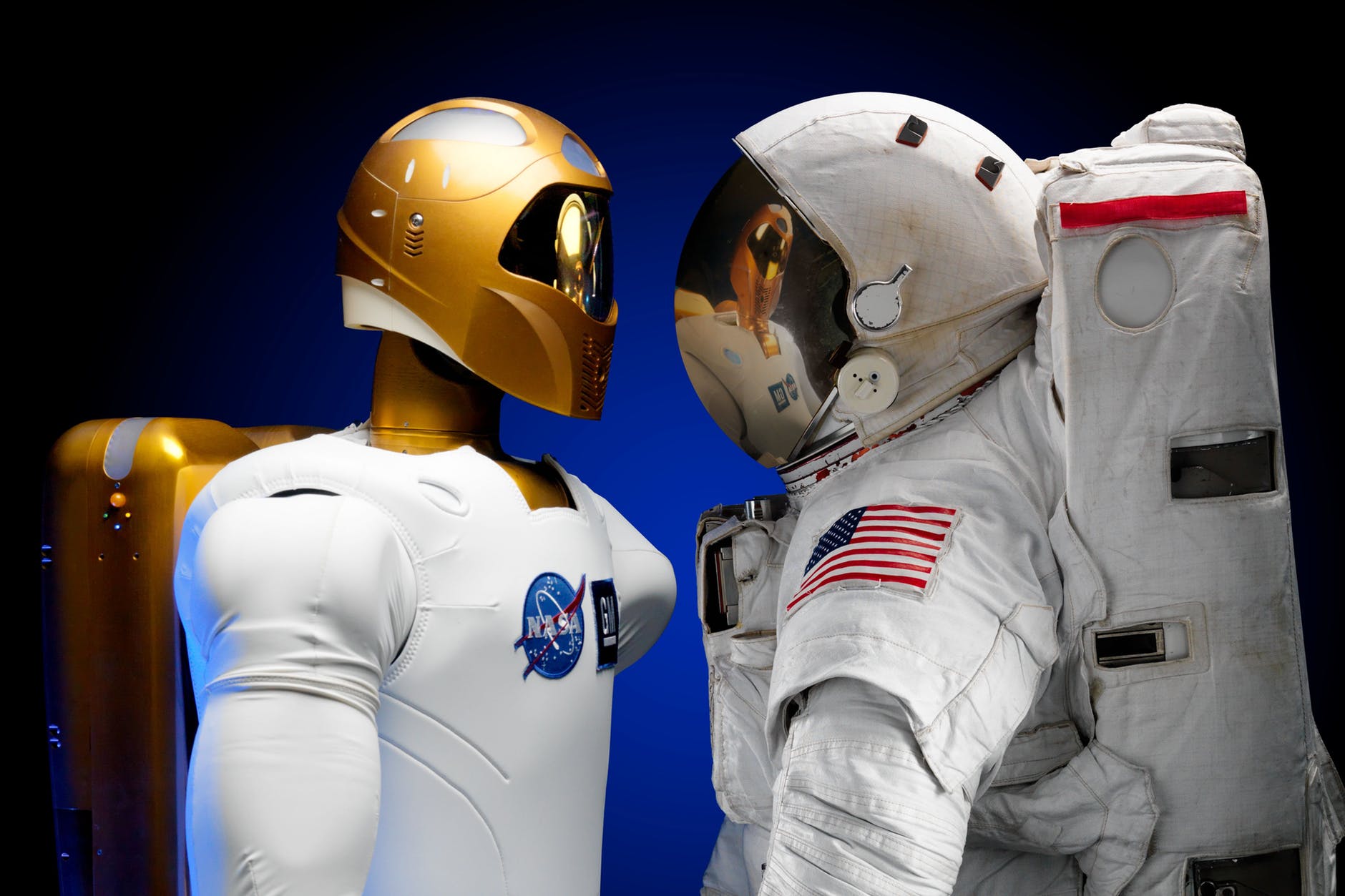
flight technology tools astronaut

Photo by Pixabay on Pexels.com

Our news media rely heavily on a social network to distribute the news and also rely on automation of trends, market derivatives, algorithms, analytics to decide which news are presented in the network prime time hours. While we have always relied on data to make decisions, what if these data are manipulated or corrupted using pesky algorithms. Which was the case during the last U.S. election. Many data were manipulated using fake news websites and pesky algorithms. As this news with shocking headlines started to trend on social media, this disinformation would be picked for its popular response and end up on the major news network, and it would take these news network days before correcting them. As a result, studies showed that many voters were influenced or suppressed by fake news. Another trend of Artificial Intelligence is how advertisement is delivered to individuals using personal information collected by the browsers that you used and email accounts.

All the information or communications that you send or share using social media are collected to create smart ads. Eventually, all ads that anyone will see online on T.V. will be tied to their purchase and web activities. These ads will know the clothes that we want to buy and predict the trips or vacations that we want to take or direct us to our weekend activities.  These data used by smart ads are considered as predictors and are used in rudiment machine intelligence that can distribute contents online. On social media it can be the suggested friends, pages, news and other info; in the market, visual advertisement will showcase the foods that they think we want to buy and where they are located, GPS already pre-program your daily trips of the places we usually go or will want to go, the streets we drive on to go to work and school, or anywhere else.

Basically, what we human have been seeking are automations in our lives to make things easier, and once you tie these automations with machine who can do the actual work, that is even better. The first automations in our lives are currently seeing on the internet in the form of research results of our search engine, the GPS mapping, the algorithm results of our newsfeed or trends report. However, these automations will evolve into A.I. Through information gathering, how far are we in that evolution? How it had affected or will affect our jobs in healthcare industry, education, transportation, service industry and auto-industry based on data reviewed through multiple interviews by experts in this matter, university reports and other documents and articles. Some have a doom’s day prediction, and others believe there are the way to prevent a total takeover of A.I. in our lives, while others believe that it will be for the best. For example, according to a PWC study, 38% of U.S. jobs could be lost to automation in the next 15 years. However, the first solution is to know that A.I. is already there and we will get stronger going forward. The first step is to know which jobs will be affected by it and how. In addition, if you just look at what projects major companies are currently working on right now, we can have a clear picture of what jobs will be directly affected incrementally or immediately. These projects are: self-driving truck (Mercedes), self-driving cabs (Uber, Lyft). Ordering kiosk currently in use in some companies (Mc Donald, Burger King), robot servers (McDonald), Ordering and transaction cart (Publix, Walmart), mail delivery drones (Amazon), self-driving planes, drones (Boeing, Lockheed Marten), Automatic Teller system (Citibank, Bank of America, CHASE), Automated 3D Printers, Rudimentary Machine Intelligence (Facebook, Google), Deep Mind (Facebook, IBM, Google). These are just a few developments in the technological pipeline that would eventually make some current jobs more effective or obsolete; Our goals is to find out how.

Transportation

Artificial Intelligence projects that will impact our transportation system in the future are many: self-driving cars, self-driving trucks, GPS control system, and deepmind. One of the most advanced projects is the alliance of Mercedes with Udacity using their advanced A.I. software name nanoDegrees to create a self-driving truck. Udacity has also teamed up with Uber to come up with a self-driving taxi. Both projects are currently on trial stage. Upon full automation or development, these projects might affect 3.4 million jobs. The main purpose for these projects is the avoidance of human errors like truck drivers sleeping during a long trip and they expect the self-driving cars to be more effective on time and delivery. So far, all test show that they might need a driving monitor, especially in the truck trials (S1).  According to the U.S. Bureau of Labor Statistics, the jobs at risk are 2.4 million truck and delivery drivers, 180,000 taxi drivers, 160,000 Uber drivers, 500,000 school bus drivers, and 160,000 transit bus drivers. For this technology to function well it will need the assistance of other AI technology like the GPS, Deepmind, Robotic features, and Cognitive analysis. Currently, a car can self-park, summon, and stay on auto drive. The problems to resolve are test-driving car accident due to missing yellow light, resolving issues with aggressive drivers (S 7, 8). Other projects by other companies that are also in the trial stage:

  1. Self-driving cars Google (S 1,8) (Google car has driven on its own for 1,5 million miles, only 300 thousand miles were without an accident)
  2. Self-driving cars Apple (S 1,8)(no data)
  3. Self-driving cars Tesla (S 1,8) (no data)

The predictions and case study published by the White House in 2016 and conducted by the Council Economic Adviser (CEA) estimated that 2.2 to 3.1 million current part- and full-time U.S. jobs may be endangered or greatly changed by Automated Vehicle technology. Essentially, CEA also confirmed that this does not calculate the types of new jobs that may be created—but rather a calculation of existing jobs that are likely to be affected by AI-enabled AV technology. A second warning is that this technology may take years or decades to happen because there will be a delay especially for safety requirements between technological possibility and widespread adoption. There will also be a delay of adaptation or acceptance by the public.

However, as reported in the journal Artificial Intelligence, Employment and Income by Nils J. Nilsson, new infrastructures will also be needed in order to accommodate these transformative changes in the transportation industry, which in turn will result in creating new jobs.

Automobile Industry

There are two A.I. technologies who have already affected the auto industry, robotic technology, and 3D printing. From the first robot used by GM in 60’s, 70,000 robots are currently in use in the United States. Auto manufacturing jobs have gone from 1.1 million to 532,000 (S 13, 8). Another technology affecting the auto industry is 3D printing that is currently in use to print auto parts (S 14, 8), however, it is projected that by combining robotic technology with 3D printing the auto industry will be again completely transformed as far as the labor force is concerned.

Construction Industry

Another industry that is affected greatly by 3D printing is construction. Companies all over the world are already showcasing their construction work using 3D printing. Each company has developed its own technology: from WATG who used carbon fibers and plastic to construct a freeform structure, CO2NCRETE who collects carbon dioxide from the air and turn it into concrete print stock, and Emerging Object who 3D print bricks. These technologies are already in use. It is estimated that 12 million will be affected by these new technologies, jobs such as welder, masons, and construction materials shop and warehouses (S 15,8).

Healthcare

Healthcare workers will have many AI technologies in their crosshair either as tools or as replacement workers: 3D Printing/ bio-printing that are currently in use, robotic assistant currently in use, and deepmind already in use by many hospitals around the World.  36,000,000 can be affected by these new advancements.

3D printed implants and prosthetics are already in use and can be printed at the recovery center. It is not clear what jobs will be affected except the manufacturing companies who used to build these prosthetics and implants. However, manufacturing jobs will be created to build these printers. Bioprinting is currently under development and will be able to print organs for transplants on the spot at the clinic or hospitals.

Medical and pharmaceutical companies are using robotic technology as a mean for drug delivery, and operation. Robotics already created and sold robotic that can assist a doctor in operation rooms. Johnson and Johnson’s Sedasys system received FDA approval to provide anesthesia for standard procedures like colonoscopies. A doctor managing multiple machines at once can reduce the medical cost instead of having a dedicated human anesthesiologist. Many robots are in various stages of testing and approval for diagnosing disease. For example, IBM’s Watson demonstrated a higher rate of accuracy for diagnoses than human doctors.

When it comes to services all technologies are welcomed: Internet of Things (IOT) already in use, deepmind in use, algorithm, smart ads are been utilized by retail companies, finance and banking services. This industry employs more individuals than any other industry, 126,000,000 as of March 2017.  As a result, all tech companies that are involved in an A.I projects, Google, Facebook, IBM, Microsoft are very much vested in DeepMind and already in use. Currently, most phone calls inquiries made to any major companies are handled by artificial intelligence or automatic phone response system that is becoming more efficient by using voice responses instead of key responses. DigitalGenius, for example, has created an automated customer service which enables companies to automate basic questions and answers, and even chats with customers by harnessing natural language processing and machine learning to create reactions. Robots can now impersonate human speech patterns to provide service that is fast and easy to consumers, and very inexpensively for companies.

From Finance to shopping, the service industry is experiencing a rapidly increasing amount of data. Some financial services companies are turning to artificial intelligence to keep up with demand. Robots are using predictive systems and market data to forecast stock trends and manage finances. Financial advice is becoming automated, with a growing trend towards “roboadvisers”” that automatically dispense advice and suggestions to financial clients, especially those with relatively simple financial problems. Robots is using a variety of algorithms to provide recommendations that best meet clients’ spending, saving, and investment habits. Altogether, 174 million jobs have been or will be affected by A.I. technologies. That is more than half of the U.S. population.

Chart Analysis

Other projected data about the labor force were presented as charts by PWC, and outcome tables by the Executive Report by the White House in 2016. For example, the flip that will eventually occur from higher numbers having more workers at the high-value function than the low-value functions as it is now.
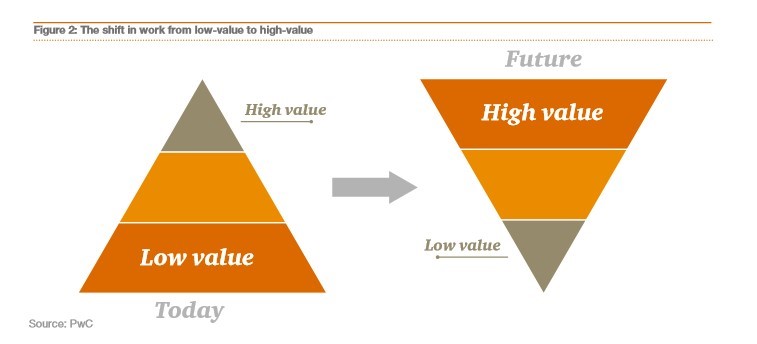
Graph1

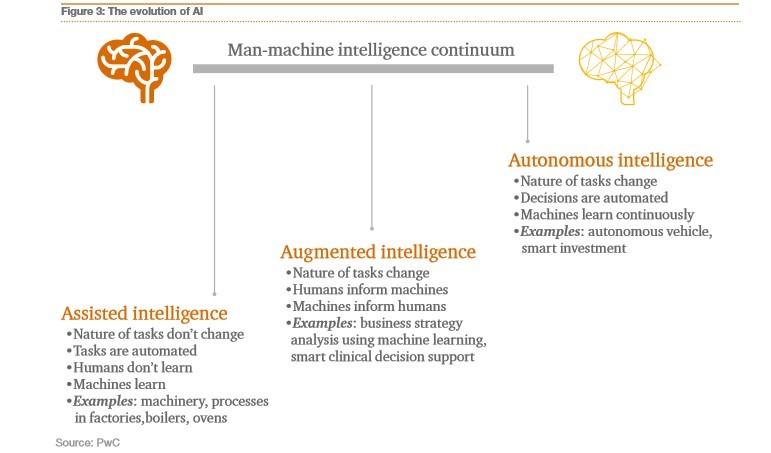
The reason for this shift as shown in the second graphic by PWC, the labor tasks as A.I. evolves from assisted intelligence, that is now, to augmented intelligence, then to autonomous intelligence.
Graph2

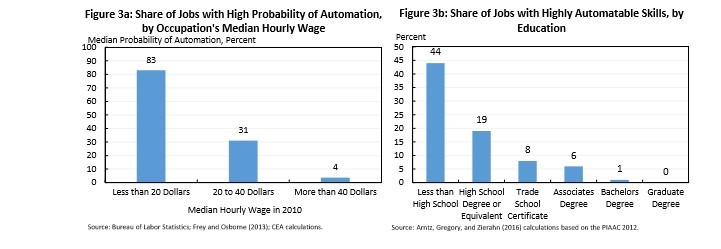
The Executive reports provided by the White House and charts created by BLS, CEA, and PAAC seem to agree with the PWC forecast that highly educated or skills workers and high paying jobs will be the less vulnerable, and lowly educated workers and the least paying jobs will be the most vulnerable:
Graph3

Based on these charts provided by the Bureau of Labor Statistic, the less money a worker earns per hour, the higher the probability that their job will be replaced by automation. Similar effect will be felt by workers who have less than a high school diploma than a worker with a higher degree. However, the executive report proposed that the A.I. development and implementation be done incrementally to avoid irreversible negative impact to the labor market (S 6, 7, 8).

In conclusion, I believe that A.I., in general, should be part of every government local or national consolidated planning for the future that they put out every five to ten years. They cannot be caught off guard by new business models using A.I., and the private companies may have to also play a role in collaborating with these local businesses, national and local governments before launching projects that may have big economic impacts. Because we will not want in the future, Uber drivers attacking autonomous Uber vehicles.

Sources

  1. Nils J. Nilsson (Summer 1984) Artificial Intelligence Center SRI International Menlo Park, California 94025. ” Artificial Intelligence, Employment and Income (http://ai.stanford.edu/~nilsson/OnlinePubs-Nils/General%20Essays/AIMag05-02-002.pdf )
  2. Report of the 2015 study panel ( September 2016) Stanford University” artificial intelligence and life in 2030 one hundred year study on artificial intelligence | (https://ai100.stanford.edu/2016-report)
  3. MICHAEL MILLS (November 3, 2015). What is artificial Intelligence (“AI”)? What is AI doing in law? Who is doing it? And where is it headed?” Artificial intelligence in law – the state of play in 2015?(https://www.legaltechnology.com/latest-news/artificial-intelligence-in-law-the-state-of-play-in-2015/)
  4. PWC A.I. Report (2017). This original research unpacks key ways AI may impact our world, delving into its implications for society, service, and management. (https://www.pwc.com/gx/en/issues/data-and-analytics/publications/artificial-intelligence-study.html)
  5. Cornell University A.I. Project Pipeline (2017) (http://www.cs.cornell.edu/courses/cs478/2001sp/mllinks/interesting_ai_demos_and_project.htm)
  6. Jason Furman John P. Holdren Chair, Council of Economic Advisers Director, Office of Science and Technology Policy, Cecilia Muñoz Megan Smith, Director, Domestic Policy Council U.S. Chief Technology Officer, Jeffrey Zients, Director, National Economic Council (2016). Artificial Intelligence Automation and the Economy, Executive Office of the President. (https://www.gpo.gov/fdsys/pkg/DCPD-2015CHECKLIST/pdf/DCPD-2015CHECKLIST.pdf)
  7. Cromwell Schubarth (Sep 13, 2016, Updated Sep 13, 2016) Silicon Valley Business Journal, “Udacity teams with Mercedes, others, to train selfdriving cars tech engineers” (https://www.bizjournals.com/sanjose/blog/techflash/2016/09/udacity-teams-with-mercedes-others-to-train-self.html)
  8. Bureau of Labor Statistic all labor data (bls.gov)
  9. Multiple Writer (July 1915–July 2015). The Monthly Labor Review through a century of economic transformation (https://www.bls.gov/opub/mlr/2016/article/pdf/the-monthly-laborreview-through-a-century-of-economic-pdf)
  10. James Brown (2012). The future of the economy is in STEM,” “Intro to tomorrow’s jobs” (https://www.bls.gov/careeroutlook/2014/spring/art01.pdf)
  11. Google DeepMind: What is it, how does it work and should you be scared? (http://www.techworld.com/personaltech/googledeepmindwhatisithowitworksshouldyoubescared3615354/)
  12. Carl Benedikt Frey and Michael A. Osborne ( September 17, 2013) THE FUTURE OF EMPLOYMENT: HOW SUSCEPTIBLE ARE JOBS TO COMPUTERISATION? (http://www.oxfordmartin.ox.ac.uk/downloads/academic/The_Future_ of_Employment.pdf)
  13. Tom Ahlborn (2011). Industrial Robotics in the Automotive Industry https://www.bastiansolutions.com/blog/index.php/2015/09/17/industri alroboticsautomotiveindustry/#.WRINukXyvcs
  14. Multiple authors (2017).  What is 3D printing? https://3dprinting.com/whatis3dprinting/
  15. Nick Hall (2016. Top 10 3D printed construction innovations https://3dprintingindustry.com/news/top103dprintedconstructioninnovations83578/

References

  1. Chan Connie (2017). 5 Industries Being Most Affected By Artificial Intelligence. https://www.fowcommunity.com/blog/futurework/5industriesbeingmostaffectedartificialintelligence
  2. Anna Sekaran (2016) IBM Media Relations. Industry Leaders Establish Partnership on AI Best Practices.  https://www03.ibm.com/press/us/en/pressrelease/50668.wss
  3. John Ward (2012) International Trade Administration Journal. THE SERVICES         SECTOR:  HOW BEST TO MEASURE IT? http://trade.gov/publications/itanewsletter/1010/servicessectorhowbesttomeasureit.asp
  4. Elizabeth Weise (2016). USA Today. Amazon just opened a grocery store without a checkout line. https://www.usatoday.com/story/tech/news/2016/12/05/amazongosupermarketnocheckoutnocashiersartificialintelligencesensors/94991612/ (not reviewed, not journal)
  5. AUTONOMOUS VEHICLES | SELF-DRIVING VEHICLES ENACTED LEGISLATION   (2017). http://www.ncsl.org/research/transportation/autonomous-vehicles-selfdriving-vehicles-enacted-legislation.aspx

by Schiller Ambroise

AN experienced professional with a demonstrated history of working in the non-profit industry. Skilled in Nonprofit Organizations’ capacity building, Entrepreneurship, Event Management, Public Speaking, Resources Development, and Marketing. Strong community and social services experiences with continuing studies in Criminal Justice/Law focused in Social Justice and crimes, International Law, Business Management, and Cyber Security from St. Thomas University.

Schiller Ambroise

Schiller Ambroise

You can find more about him on LinkedIn at https://www.linkedin.com/in/schiller-ambroise-98717b19/

Follow him on Twitter at https://twitter.com/aschiller2
Strategic use of technology can grow your business; a look at the grocery retail industry

In the United States shopping for groceries (along with baseball and football) is a national pastime. Though the average household’s weekly spending on groceries continues to increase annually, these grocery dollars are now distributed amongst multiple shopping channels and the industry is highly fragmented. The problem of how to differentiate yourself from the competition and grow market share in a highly fragmented and competitive marketplace is not unique to the grocery retail industry but let me use it as an example here:

Limited-selection discount stores, Natural and Organic stores, Warehouse stores, Supercenters, Specialty stores and a growing number of Online retailers now compete with traditional supermarkets for every grocery dollar. Thus, the grocery retail industry is an extremely competitive marketplace. Price-conscientious U.S. consumers are increasingly prepared to shop multiple channels for their groceries. This multi-stop shopping should serve as a warning for the traditional grocery store operating using a traditional supermarket model and reluctant to change. Faced with the problem of growing competition, grocery retail outlets must seek out a competitive advantage to strategically differentiate themselves from the competition and make themselves relevant to the consumer.

grocery cart with item

Photo by Oleg Magni on Pexels.com

Competitive differentiation and increasing market share may be realized by employing a variety of strategic evidence-based initiatives that include, but is not limited to; strategic mergers and acquisitions to leverage economies of scale, strategic price reductions to compete on price with competitors, and the strategic use of smart technologies and automation to facilitate differentiation based on an improved customer experience.

I believe that a strategy to improve market share that is based on the strategic use of smart technologies to improve the customer experience, increase margins and drive sales may, in fact, be the most successful. The use of technology to improve the customer experience with an emphasis on convenience, personalization, transparency, and freshness may successfully differentiate your company from the competition.

We all know that shopping for groceries at the local supermarket can be a frustrating experience, but did you know that it can also be hazardous to your health? For some, supermarket shopping may be a significant cause of stress, hypertension, and cardiovascular disease. The problems, hazards, and frustrations associated with supermarket shopping, all contribute to a negative customer experience. Grocery retailers are therefore challenged to utilize technology to make the consumer experience more convenient, more personal, more enjoyable, less time consuming and even less hazardous!

What we are now observing in the grocery retail industry is a significant transformation with online giants like Amazon moving to establish a “bricks and mortar” foothold in the industry, and traditional stores such as Walmart, moving into the online digital e-commerce space to increase their market share. Though online grocery shopping still remains a small fraction of the industry, the transition to the online arena is increasing not surprisingly with both Amazon and Walmart leading the way in this online migration. Amazon has formed a strategic partnership with Google to increase their presence in the digital marketplace and is currently utilizing artificial intelligence to inform pricing and promotions and is experimenting with voice ordering technology. In this paradigm, the consumer has the option to avoid the grocery store altogether and perhaps engage in a more health-conscious activity. This alternative is currently most popular with millennials, though the convenience of online grocery shopping and associated home delivery or store pickup is also appealing to busy working parents.

Should the grocery shopper visit an actual store, then dramatic changes may be evident. Amazon recently announced that it is opening its second cashier-less Amazon Go store to the public shortly, again in Seattle, WA. This store will continue to utilize a combination of artificial intelligence and computer vision to enhance and personalize the customer experience. Amazon is currently employing the marketing mantra “No Lines, No Checkout (No, Seriously) to emphasize the convenience and stress-free nature of the checkout process and differentiate itself based on a superior consumer experience. The consumer experience is further enhanced by the widespread adoption of smart labels that satisfy the consumer’s need for transparency, whether this relates to ingredients, freshness, health, food safety or environmental responsibility and sustainability. In the background, Amazon Go’s utilization of machine learning will optimize fresh food replacement and pricing to further enhance the consumer experience (and maximize profit margins of course).

The grocery shopping experience continues to evolve as retailers embrace digital technology and social media to connect with consumers, increasing sales and growing market share. Stores fitted with Bluetooth-enabled beacons now send welcome messages, as well as targeted and personalized mobile coupons to consumers, significantly boosting in-store sales. In the future, grocery purchases made on mobile devices may be delivered by drone.

The role of the grocery retail workforce will also continue to evolve in the automation age, alongside these new smart technologies. Though in the short term, there may be some job losses a new breed of professional, capable of managing consumer experiences and technology will eventually evolve. Companies like Amazon will continue to invest in “people analytics” to optimize their workforce, maximize their staffing investments and reduce turnover. Store employees equipped with the latest digital tools will become experts, not only in product information but in providing nutritional advice, recipes and purchase recommendations, further improving the consumer experience.

Final thoughts

The use of technologies to improve the grocery shopping experience will only be possible in companies with leadership that has imagination and vision, combined with a willingness to challenge the status quo and view budgeting for technology as an investment rather than an expense. Though at present, technology implementation may only be feasible to the largest in the grocery retail hierarchy, if implemented, the transformative smart technologies used to enhance the consumer experience, may well serve as an effective solution to your problem of competitive differentiation in the highly fragment grocery retail industry moving forward.


By Graham Shaw, PhD

Dr Shaw is an experienced and innovative medical educator at Barry University’s School of Podiatric Medicine. He has extensive experience in medical education, pedagogy, and e-learning technologies. He has recently returned to school and is now an MBA student in the Andreas School of Business at Barry University.

Graham Shaw

Graham Shaw

You can find more about him on LinkedIn at https://www.linkedin.com/in/graham-shaw-3a615b40/


What cryptocurrencies do that Visa, Mastercard & American Express cannot do for your online business?

Since you can’t pay with cash online, I would venture to say that most online buyers use a credit card to pay for their purchases. If you are the online seller, you pay up to 6% or more to accept credit cards and you take a risk due to the rampant fraud on card not present transactions. Lets us assume you are an online business where budgets are tight and cannot put in place the sophisticated fraud-detection software required in your checkout process to limit or stop fraud. If this sounds like your shop then keep reading, this is for you.

The customer is always right.

If a credit card number gets cloned or stolen and you as a shopper gets charged for a shopping spree you call your bank/credit card company and reject all the charges — because it was not you making them. For the most part, the credit card companies will side with the customer and either put a hold on the transaction and even reverse the charges for the cardholder while the issue gets resolved with the vendor.

Customer protection equals loyalty.

Usually, the bank and credit card company do a very good job of fulfilling their promise to the cardholders, they will reverse all the charges and eventually get all your money back. This makes a lot of sense if you are the credit card holder, after all, you are paying for the card and all the benefits it brings with it – the credit card companies and the banks want you to keep your card and happily pay the fees every year/month. It is in their best interest to have a loyal customer.

woman holding card while operating silver laptop

Photo by bruce mars on Pexels.com

But did you ever wonder what about the hundreds of merchants who sold, shipped or served to someone using a stolen card number? Well, the short answer is they are the ones carrying the burden.

The credit card processor policy: reverse the charge first ask questions later.

If you are a merchant that accepts credit cards, most often you need a credit card processor. In short, they take the cash from your customer and deposit it into your bank account minus a few fees. That works well most of the time, until a cloned credit card transaction comes across, in which case the credit card processor will take the cash out of your bank account and “process a reversal of the transaction” — and yes they are allowed to do that for up to a year after the transaction was executed… read the fine print in your merchant processing contract. Not cool if you are the seller right?

What are the alternatives?

An alternative you might want to consider is accepting cryptocurrencies such as bitcoin or ethereum just to name a few. Payments in cryptocurrencies like bitcoin (BTC) or ethereum (ETH) are better suited for online shipping because they are irreversible. Once the transaction has been confirmed by the network, you got your payment and there are no reversals. The blockchain is immutable, no one can go back into the blockchain take your money.

The bad news is that crypto wallets (where you keep the keys to your bitcoins or ethereum) are not as prevalent or as widely accepted as credit cards are today. Just ask around how many people in a room have a credit card on their wallet vs how many have a crypto wallet (even though the vast majority are free and pretty easy to use as an app on your phone).

Who will drive the adoption of cryptocurrency?

Consumer have a solution in their pockets already, they have cash and credit cards. They are not the ones feeling the pain and neither are their banks or Visa, MasterCard or American Express, those guys are making millions of dollars on transaction fees. It is the online shops who have the problem, and it is them who need to start changing the habits of their consumers to prevent the millions of dollars lost to credit card fraud.

Cryptocurrencies are not hard, you already know how to use them.

If you know how to use Venmo, PayPal, Square, Snapchat, Facebook, WhatsApp, Tinder, Instagram or Twitter, you already know how to use a crypto wallet in your phone. It is as easy as to download a reputable wallet like MyCellium, Blockchain, Xapo, Ethereum or Jaxx. If you are a retailer, you might want to try Coinbase or a cryptocurrency enabled shopping cart.

The most important step is to get educated on this new technology, because it will save you lot of money in the long run, and that is something Visa, MasterCard or Visa cannot do today.

If you want to learn more about how using cryptocurrencies or using blockchain technology can save you money, contact me via LinkedIn https://www.linkedin.com/in/powermeza/

How to reset your crypto wallet password.

In the early days of bitcoin, I jumped at the opportunity to learn something useful and new and in the process change the world. That was waaay back when I could mine enough bitcoins on my desktop so I could trade some and give some away. This was the time when bitcoin was “really cheap”.

I was very excited about the new technology and have given many of my friends a few bitcoins; to show them how this new thing worked. Naturally, my friends surely thought “…here he comes with yet another one of his inventions…” and politely listen to my explanation of the blockchain, loaded the app on their mobile phones, created their wallets, accepted the bitcoin and nodded and smile a lot as I ranted on and on about how this was going to transform and empower people in the future.vid.project2

Fast forward a few years when the price of bitcoin moved above $10,000.00 USD and kept going up a few months ago, I started to get calls that roughly went like this:

my friend: “Hi there, do you remember when you gave me those bitcoins?”

me: “Yes, I remember, can you believe it, they are worth a small fortune now!”

my friend: “Well yes, I want to sell them, but I forgot the password for my wallet, do you know how to do a password recovery or how to reset the password?”

me: “well… [long silence], you see, there is no such thing as a password recovery method that I know for X wallet…”

my friend: “Huh? [you can kind of hear a big gasp], what do you mean there is no password reset?”

The privacy, security and fraud triangle

Bitcoin was designed with the idea of privacy and decentralization. This was accomplished by using very high security. The dark part of privacy is that it lends itself to fraud. And in order to implement anti-fraud measurements, you need to expose the participants on a transaction. By now you should begin to figure out it is an all or none type of conundrum.

In summary, if you lost your wallet password (keys or PIN) there is not a place, person, organization that has a way to re-issue a new one like they do at your local bank, because it will violate your privacy and security, and will expose you to fraud.

The distributed ledger part

At one conference I overheard someone explaining to their friend about the blockchain, it is a difficult concept to grasp for a non-techie, and I was sensing a bit of frustration on the guy trying to explain it to this friend until he said: “Man… the blockchain is in the cloud!”. What I think he meant is that it is not centrally located, everyone (kind of) has a copy on their machine of the blockchain, so it is technically not in the cloud but it kind of is. The key take away here is that because it is not owned or controlled by a central organization, it is up to each an everyone to look after your own keys (aka passwords). The cool thing about the blockchain ledger is that you can inspect any account on it as well as all the transactions on it.

Let’s repeat it together 3 times: increase security, increase security, increase security.

I spend a lot of time analazing, new technology, new and innovative companies, ICOs (aka Initial Token Offerings), funds and more to invest on (or not). I am not a financial advisor nor I play one on TV, and I dont recommend anyone getting into something he or she is now knowledgeable about. But there is ONE thing EVERYONE should do: increase your level of security. I started a new practice a few years back; now when I start to teach anyone about how to get into crypto trading I have them adopt a new mantra. It is very simple, I tell them to repeat three times what is the first thing and the most important thing they need to do to keep their investments safe: increase security, increase security. increase security.

This of course means don’t forget your password but go the extra length to secure your wallet keys (maybe use hardware wallets), use very long passwords (maybe use LastPass), implement two-factor authentication (2FA) on all your accounts or use a YubiKey and if you must exchange sensitive information encrypt your emails (maybe use Virtru) or use a fully encrypted email service like ProtonMail for example.

It is sometimes inconvenient, but believe me, it is a small price to pay not to lose your money. One more for extra credit — if you have old email or social media accounts that you do not use, close/delete them. Same goes for old blogs, picture sites, or accounts in e-stores you no longer buy from. Remember, someone trying to hack you to gain control of your bitcoins will go through ALL your accounts, old PCs, old USB drives, etc to gain information they can exploit.

If you can’t remember your password we should thank you!

I am truly very sorry for those friends of mine and everyone else who lost access to their wallets; they technically lost a small fortune. There are people advertising ways to recover access, but the reality is that it is not that simple. In the bright side, the amount of bitcoins that will ever be minted is fixed and thanks to all those who lost their keys, the number of bitcoins in circulation will slowly shrink and therefore the value of the ones available to trade will increase… and for that, we should thank you.

In short, don’t lose your password!

Should I move to Silicon Valley to immerse myself in technology and entrepreneurship?

I get asked this question a few times a year so it is time to write a post about some of the most common misconceptions of being in a wrong or right place.  It is very true that there are a lot of factors, but let’s explore two, what your potential customers think and what your potential suppliers/employees think.

Your customers won’t really care where you are as far as you have a great product/service.

Think about it for a moment, unless your product or service has a strong correlation to its origin, like Champagne or Tequila, does it matter where it was made? For most people the answer simply is no; for most customers, good quality and price are more important.  The point I am trying to make is that unless your product falls on a specific category were location is part of the brand, where you are is not so important.Golden Gate

For many companies, the “where something is made” is just a function of either cost or closeness to raw materials. This two factors will have the greatest impact on location, so let’s expand on that because costs and the sourcing of raw materials are intrinsically intertwined. For example, if you are close to the providers of raw materials then your costs might be less, but the place where you need to deliver your products is far you might need to add the cost to ship your products.

The same hoholdsrue for some services, it might be cheaper to service a customer from an offshore location, but you might incur additional overtime because the service time window is not the same.  For many transnational corporations, this is a constant balancing act, as new markets emerge and competitive pressures drive prices down, they must constantly find better ways to extract the cost from the process of manufacturing their products and deliver their services.

The other key ingredient of successful entrepreneurial ecosystems is the ecosystem itself.

While it is true that Silicon Valley has lead the high-tech revolution and as a byproduct created one of the most successful entrepreneurial ecosystems, it is not the only one. There are many thriving entrepreneurial ecosystems in the USA and around the globe. Some exist as byproducts of beneficial economic conditions and other were purposely created to fuel the improvement of economic conditions. There are great examples all over the world, all the way from Chile to Israel, from Miami, Austin, Boulder to Shenzhen China ( The Silicon Valley of Hardware https://www.youtube.com/watch?v=SGJ5cZnoodY )

So you are thinking about going to Silicon Valley in order to start a career and get immersed in high-tech; First of all congratulations, you have chosen one of the most exciting paths I can think of. Entrepreneurship and technology will continue to be areas of incredible growth for many more years. Historically, Silicon Valley has been the place to be surrounded by like-minded people. One does not need to wander too far to find some interesting places to land, for example, Startup Embassy ( http://www.startupembassy.com/ ) is the oldest entrepreneurial residence located in Palo Alto. They provide a soft landing for international tech entrepreneurs they claim to be a community of like-minded founders and provide collaboration, living and workspace. In short, Silicon Valley’s ecosystem does a good job welcoming people (https://youtu.be/r44RKWyfcFw ) but the key point is that there are many other great places too.

So you see, where one should go really depends; like the Cheshire cat in Alice in Wonderland says ( https://www.youtube.com/watch?v=G4fHre-yRPY ) it all depends on what you want to do.

Drop me a line in the comments below, what would you do?  Would you pack your bags and head to Silicon Valley, Austin, Boulder, Shenzhen or Miami? If so, tell me why or why not?

Is Miami the place to catch the next Unicorn or just a bunch of mosquitos?

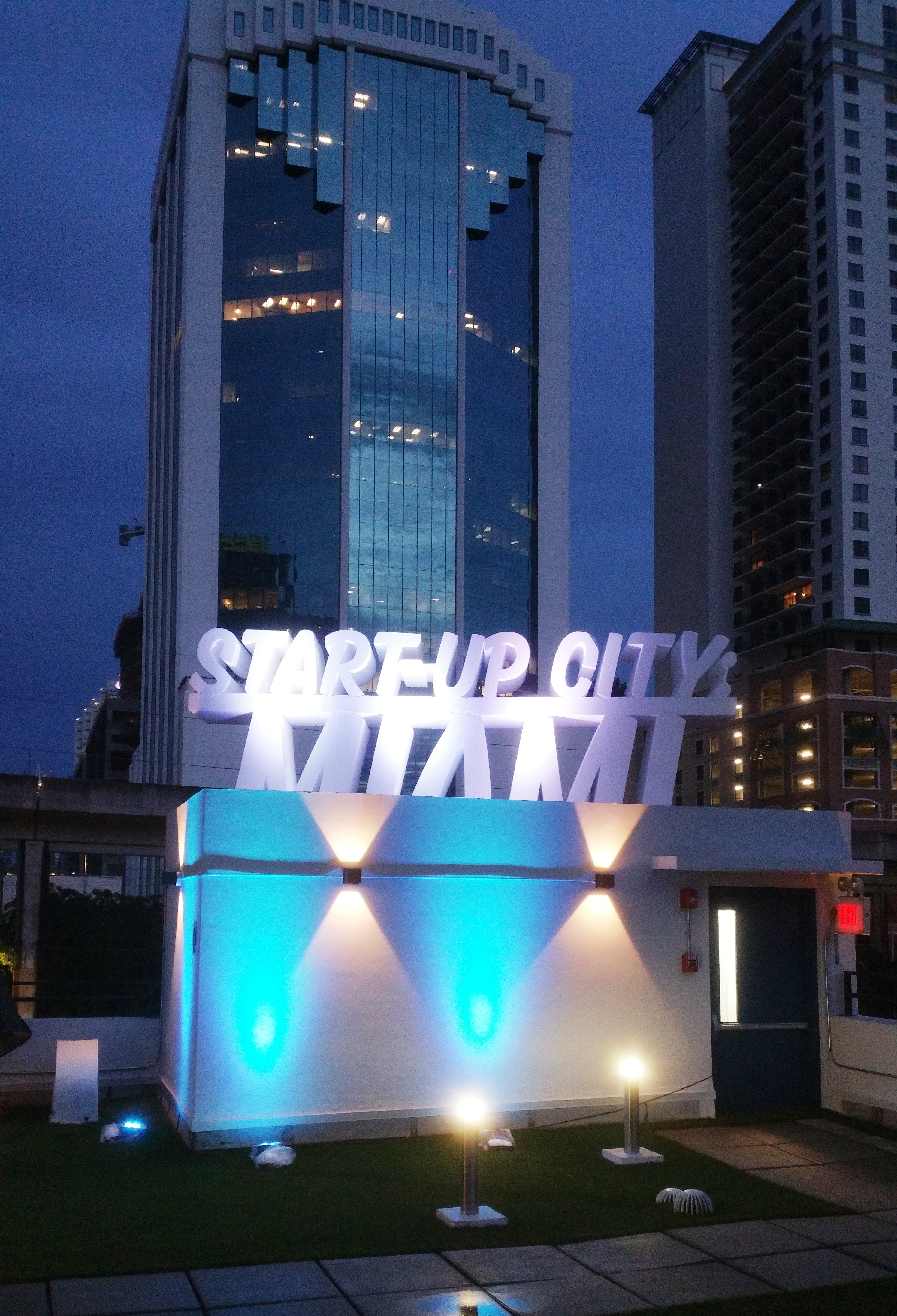
Start-up city Miami

Start-up city Miami

Sometimes opportunities reveal themselves in very subtle ways that only trained eyes can spot.  Some other times, opportunities are like a mosquitos that it just keep coming back, and keep buzzing around until you slap yourself, only to realize that you missed it.

The story of Miami and its up and coming startup scene, is turning out to be like that of the mosquito; an opportunity that you almost slapped your neck and missed it – but didn’t!

Back on September 16th, 2013, I wrote in this same blog, a post about the Miami tech scene (https://innovationstrategy4.biz/2013/09/16/is-the-super-hot-miami-tech-scene-sustainable/ ), in it I speculated if the movement that started to gain the attention of a few was sustainable, it could turn out to be something big. The post attracted some attention and was the trigger for many interesting conversations with high-tech investors and VCs in South America, Europe and the US Norths East.

Fast-forward to today and you can actually feel the vibrant ecosystem buzz with energy, very accurately represented by the sign on the terrace at the top of BUILDING.co, one of the newest and hottest co-working spaces in Miami that reads: “Start-up City Miami”.

I think the 2015 Kauffman index (http://www.kauffman.org/microsites/kauffman-index ) is not wrong, Miami has the highest startup density, and if you have already started your search to catch the next Unicorn (a company valued at $1 Billion dollars+), you most definitely need to keep a watchful eye on Miami, because if you blink, you will end up slapping your neck, only to realize that just like that mosquito, you might have just missed your chance of a life time.

Sustainability Management as part of your Innovation Strategy

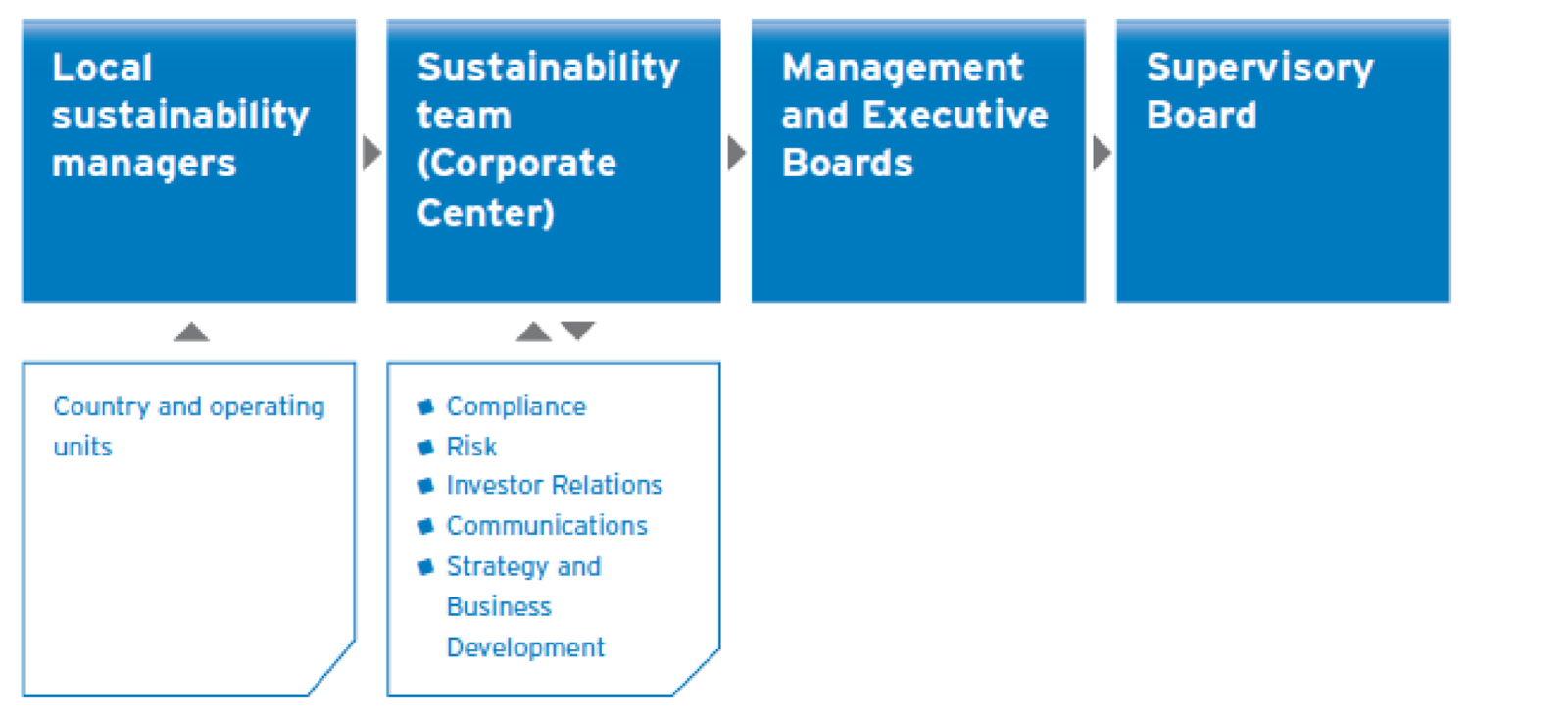
In order for a company to have a sustainable business each senior manager should have assigned responsibility for sustainability within each business unit.  Innovation strategy and sustainability management go hand in hand for future growth, and excellence in execution of ‘brilliant’ innovative ideas. The senior managers should oversee the following:

  • Implementation of local sustainability policies and initiatives.

  • Development of local sustainability policies and processes.

  • Collation of all relevant data on sustainability issues.

  • Reporting of all progress to company’s sustainability team.

In many companies and business units, individual managers might oversee sustainability activities alongside other professional responsibilities. These activities are therefore reflected in the overall assessment of the sustainability manager’s job performance.

The need for sustainability team is vital for business success, thus the company has to appoint a Head of Sustainability to execute their enterprise wide sustainability goals.

The Head of Sustainability should report to the CEO, and the organization should have a member of company’s Management Board be responsible for sustainability issues. Questions of strategy and policy are subject to approval by company’s Executive and Management Boards.

For example the Aegon company uses this innovation model and embracing sustainability management successfully with excellent results as reported in their 2012 Annual Report (what sustainability means to us).

In this business model. the responsibilities of local sustainability management include:

  • Managing the strategic framework for business unit sustainability activities; developing and introducing relevant policies; and

  • Supporting operating entities in integrating and implementing the department’s strategic approach and policies

  • Coordinating the main sustainability activities between subsidiaries, strategic functions and Executive Board of Management

  • Further integrating sustainability aspects into existing business processes and operations

  • Acting as a knowledge hub and facilitating best practice exchange across the business units

Additionally, the company might utilize existing business processes, such as Risk Management Framework, Project Management Framework and Compliance System, to establish minimum sustainability standards and monitor compliance with them.

By Tanya Petrova, MSMIS, PMP at Green PM Consulting
www.LinkedIn.com/in/tanyapetrova

Create a free website or blog at WordPress.com.