AI Video Generation in Late 2026: What Works, What Doesn’t, and the API That Shuts Down This Week

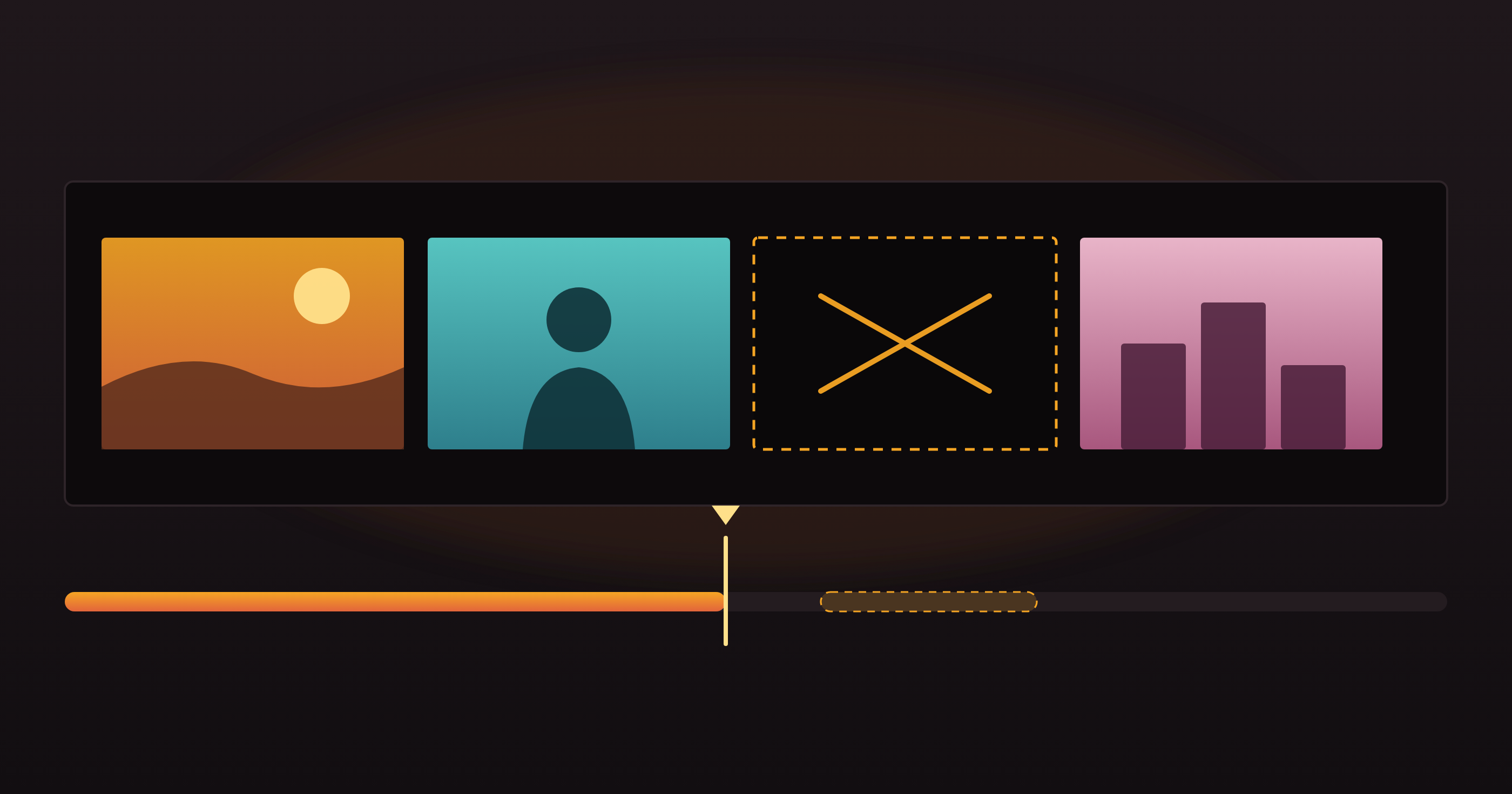
A video editing timeline with four film frames, one blacked out and crossed through in amber to mark a model that has been switched off

OpenAI removes the Sora 2 API on 24 September 2026. If you have a script, an automation, or a product feature calling it, that call stops returning video on that date. OpenAI has not named a replacement model. Most of the “best AI video tools” articles currently ranking on Google still recommend Sora near the top.

That’s the urgent part, and it’s below in detail. The rest of this post is what I’d actually use instead, and what this category can and cannot do right now.

Why this one is here

Most of what I write on this blog is about strategy. Every so often it’s worth going down to the tool level, because that’s where the strategy either works or quietly falls apart.

Building AI systems is my day job. At Omnilogic Labs we design and run AI automation for banks and enterprises, and we do that work for clients continuously rather than as one-off projects. That’s the part that makes a post like this possible. When you’re accountable for systems that other people depend on, you stop caring which model won a benchmark last month and start caring about which one will still exist next year. Those turn out to be very different questions.

This month gave a painful example of exactly that.

First, what AI video generation actually is

You type a sentence. A model gives you back a few seconds of video that never existed.

That’s the whole idea. Underneath, these systems have been trained on enormous quantities of footage and have learned what things look like when they move: how fabric falls, how a face turns, how light behaves on water. When you describe a scene, the model produces frames that are statistically consistent with everything it has seen.

Two things follow from that, and they explain most of what’s in this post.

The first is that these models are guessing, extremely well, about appearance. They aren’t simulating the world. Nothing inside them knows that a glass which tips over should spill. That’s why the failures look strange rather than merely low quality.

The second is that the good ones are expensive to train and run, which means they are products, owned by companies, subject to business decisions. A model you build a workflow around is not a permanent fixture. It’s a vendor relationship.

Which brings us to the news.

The part that’s urgent: the Sora API is being removed

If you read almost any “best AI video tools” article written this year, Sora is near the top. That advice is now actively harmful.

OpenAI announced on 24 March 2026 that the Sora 2 model and the Videos API would be removed. The removal date is 24 September 2026. The consumer Sora app was already discontinued back on 26 April.

The detail worth pausing on is what OpenAI listed as the recommended replacement: nothing. The deprecation table has an empty cell where a migration target would normally go. There is no other OpenAI video model to move to. The company that arguably started the current wave of excitement about AI video has left the category.

If you have anything automated that calls that API, it stops returning results. Not degraded output, no fallback, just an end. This is the most concrete illustration I can offer of a point I make to clients constantly: the model is not your system. Your system is what happens when the model goes away.

If you are still on the Sora API

Three things, in order.

Find every call site today. In my experience this is where the unpleasant surprise lives. It’s rarely just the one feature somebody remembers building. Search your codebase for the endpoint, then check scheduled jobs, internal tools, and anything a non-engineer wired together with a no-code platform. Those last ones are invisible to code search and they will be the ones that break loudly.

Decide what “failure” should look like before the date, not after. If a video does not generate on 25 September, what does your system do? Retry forever against a dead endpoint? Publish without the video? Alert somebody? An unhandled shutdown turns into silent failure, and silent failure is the expensive kind.

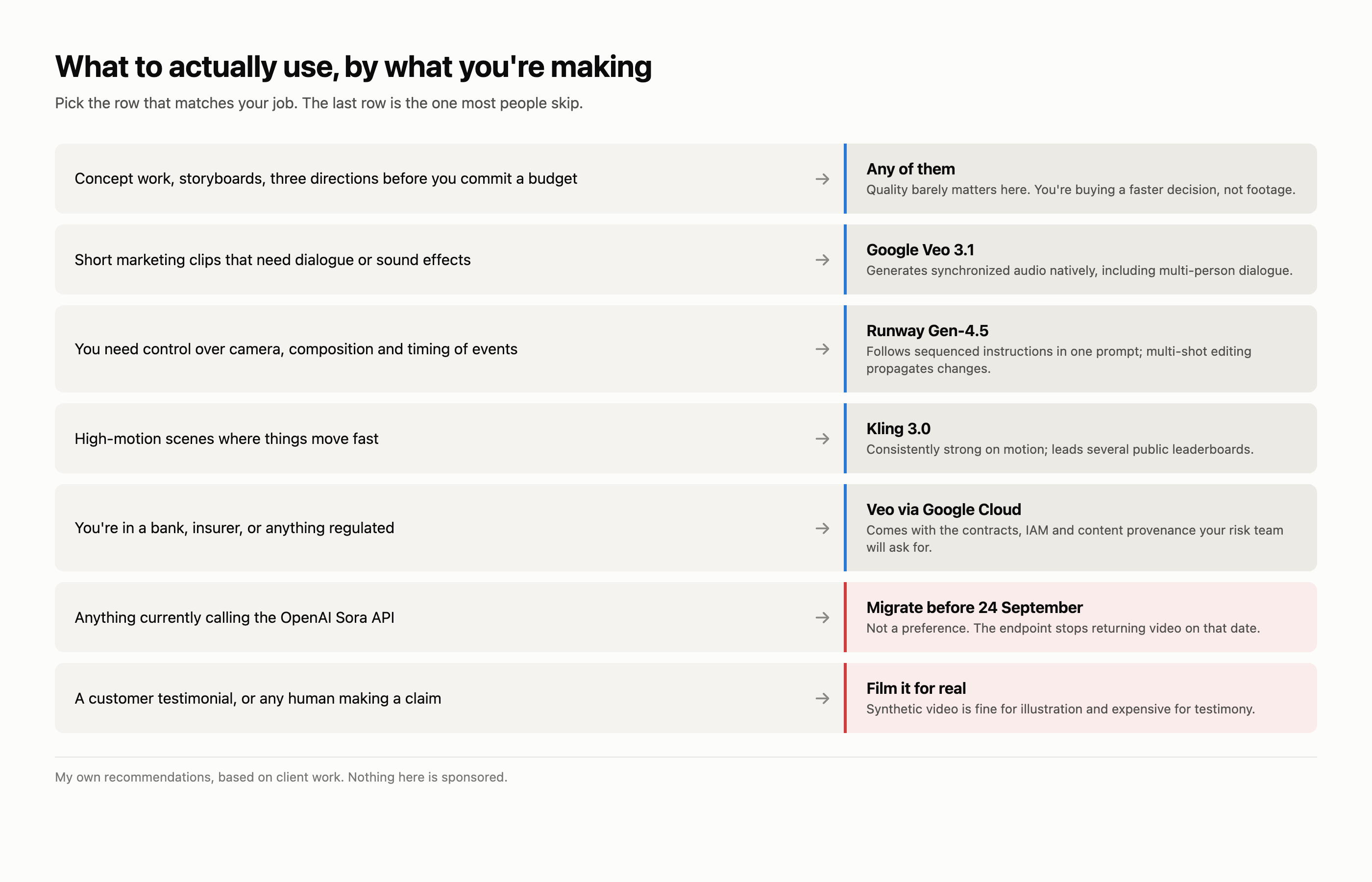
Then pick a replacement, and put an adapter in front of it. Veo 3.1 is the closest equivalent for cinematic output with sound, and it ships through Google Cloud, which matters if you need contracts and provenance. Runway Gen-4.5 is the better choice if your team needs shot-level control. Whichever you choose, do not call it directly from twelve places in your codebase. Wrap it once. The next deprecation is already scheduled, somewhere, by someone.

What actually works right now

With that said, the category itself is in far better shape than it was when most of the guides now circulating were written.

Short clips with sound, generated together. This is the genuine advance of the last year. Google’s Veo 3.1 generates synchronized audio natively, including multi-person dialogue and timed sound effects, rather than producing silent footage you score afterward. Runway’s Gen-4.5 added native audio generation and audio editing of existing video. Sound used to be the obvious tell. It isn’t anymore.

Concept work and pre-visualization. This remains the highest-value use I see. Showing a client three visual directions before anyone books a crew is worth real money, and it doesn’t matter that the output isn’t broadcast quality, because nobody is broadcasting it. It’s a thinking tool.

Controlled, deliberate shots. Gen-4.5 will follow sequenced instructions in a single prompt: camera movement, composition, the timing of events. Its multi-shot editing propagates a change made in one scene through the rest of the video. That’s the difference between a slot machine and a tool.

Anything short. Veo 3.1 generates in 4, 6, or 8 second clips, extending to a minute or more by chaining. Gen-4.5 runs 2 to 10 seconds. Notice that every one of these numbers is measured in seconds. That is not an accident, and it’s the honest boundary of the technology today.

What still doesn’t work

Length. Everything above is built out of short generations stitched together. There is no model that will hand you a coherent five-minute scene. The joins are where quality goes to die.

Consistency of a specific person or product across shots. The tools have improved at this and it is still the thing that breaks commercial work most often. Your product needs to be the same product in shot four as in shot one.

Physics. Because these models learned appearance rather than mechanics, anything involving contact, weight, or fluid tends to look subtly wrong in a way viewers notice without being able to name.

Anything a viewer must trust. This is the limitation I’d underline for business readers. Synthetic video is fine for illustration and poor for testimony. The moment a viewer suspects a person on screen isn’t real, you’ve spent credibility you can’t easily earn back. Use it for the abstract, not for the human claim.

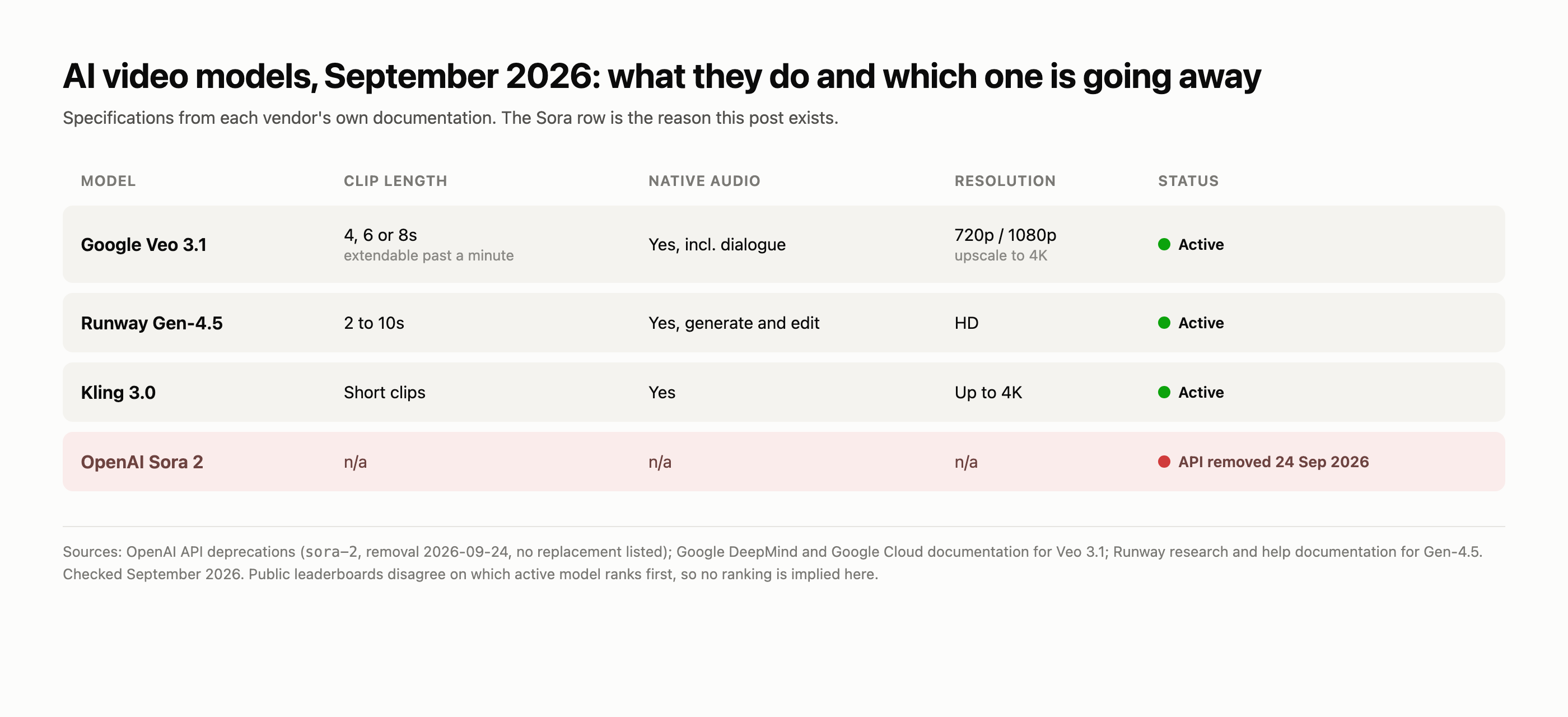
Comparison of current AI video models by clip length, resolution, native audio support, and availability, with Sora shown as removed

The current set, honestly described

Model Clip length Audio Notes
Google Veo 3.1 4, 6, or 8s, extendable past a minute Native, incl. dialogue 720p/1080p, upscaling to 4K. Three tiers, Lite is the cheap one. Ships through Google Cloud.
Runway Gen-4.5 2 to 10s Native generation and editing Strongest control surface. Multi-shot editing. In the API since 10 February 2026.
Kling 3.0 Short clips Yes Strong on high-motion scenes. Leads several public leaderboards.
OpenAI Sora 2 n/a n/a Removed 24 September 2026. No replacement.

One caveat on rankings, because it matters and most articles hide it. Different leaderboards currently disagree about which model is best. Runway reports Gen-4.5 at the top of the Artificial Analysis text-to-video benchmark; other public arenas put Kling ahead. Both can be true, because they measure different things with different voters. Treat any article that declares a single winner with suspicion, including this one. Test on your own material.

Decision guide matching common video use cases to a recommended approach, including when not to use AI video at all

Where this earns money, and where it burns it

The question I actually get asked is not which model is best. It’s whether any of this is worth the trouble yet. For most businesses the honest answer is “for some things, clearly yes, and you should be careful about the rest.”

It earns its keep in pre-production. Storyboards, mood pieces, three visual directions for a campaign before anyone commits a budget. The output does not need to be broadcast quality because it is never going to air. It exists to make a decision faster. This is the use case I would start with in almost any company.

It earns its keep in volume where the stakes are low. Product B-roll, background footage, social filler, internal training segments that currently do not get made at all because commissioning them is not worth it. The comparison here is not “AI video versus a film crew,” it is “AI video versus nothing,” and nothing is what most companies currently produce.

It burns money on anything that carries a claim. Customer testimonials, executive messages, anything where a viewer needs to believe a specific human said a specific thing. Not because the technology cannot do it, but because the downside when someone notices is much larger than the production cost you saved.

It burns time when teams expect finished output. The single most common failure I see is a team generating clips, finding them 80 percent right, and having no plan for the remaining 20 percent. Generated footage is raw material. If nobody on the project owns the edit, the project stalls at “impressive demo.”

What I’d actually tell a client

Don’t build on a single model. This is the Sora lesson and it cost some teams real money. Put a layer of your own between your workflow and whichever model you’re calling, so that swapping providers is a configuration change rather than a rewrite. We do this by default now.

Budget for the edit. Generated footage is raw material. Teams that plan for post-production get usable results; teams that expect finished output get frustrated and conclude the technology doesn’t work.

Pick by constraint, not by benchmark. If you’re in a regulated industry, the model that ships through your existing cloud vendor with proper agreements and content provenance is worth more than a slightly better-looking competitor. Veo running through Google Cloud is a different procurement conversation than a startup’s API.

Decide your disclosure policy before you need one. Not because regulation demands it yet in most places, but because getting caught having not decided is worse than any policy you’d have chosen.

The lesson underneath

I’ve written before that the hardest part of production AI isn’t the model, it’s everything around the model. Sora’s shutdown is that argument made concrete, on a specific date, with no appeal.

The teams that will shrug this week are the ones who treated the video model as a replaceable component. The teams having a bad week are the ones who treated it as a foundation. Nothing about the quality of the model distinguished those two groups. Only the architecture around it did.

That’s the whole job, really.

Sources

Specifications change frequently in this category. Everything above was checked in September 2026. Check it again before you commit to anything.

A note on how this gets made: I run my own content pipeline, the same kind of system I build for clients. It drafts, I edit and fact-check every line, and I sign it. Claiming expertise in production AI and then hiding that I use it would be a strange way to make the point.

— Juan
The 12 Multi-Agent AI Frameworks I’d Actually Build On in 2026 (And 3 I’d Avoid)

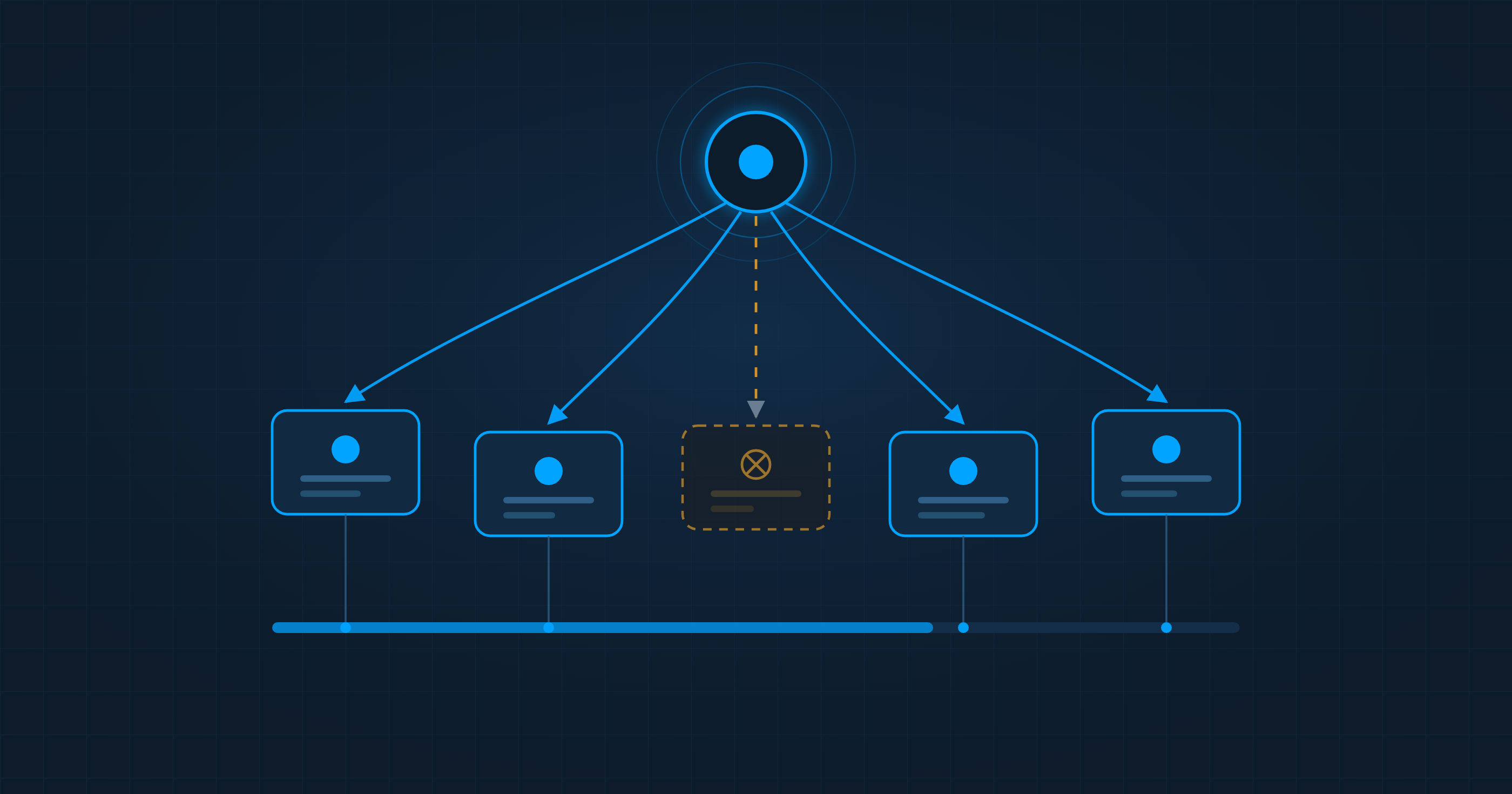
Five agents coordinated by an orchestrator over a shared state bus, with one deprecated path drawn as a broken amber line

Why this one is here

Most of what I write on this blog is about strategy. This post gets closer to the workbench, so it’s worth saying why.

Building AI systems is my day job. At Omnilogic Labs we design and run AI automation for banks and enterprises, and we do it for clients on a regular basis. That repetition is the part that matters for this post. When you build the same class of system over and over, for companies with real deadlines and real money at stake, you find out fairly quickly which tools hold up and which ones only look good in a tutorial. You don’t learn that from documentation. You learn it on the third client project, when the thing you picked turns out to be the wrong choice and you have to explain why.

What follows is that accumulated view, written down.

First, what a multi-agent framework actually is

If you’ve used ChatGPT, you’ve used a single AI agent. You ask, it answers, the conversation ends. You are the one deciding what happens next.

A multi-agent system is what you get when you stop asking one AI to do everything and instead hand narrow jobs to several of them, letting them pass work to each other. Think of a small agency rather than a single freelancer. One agent researches. Another writes a draft. A third checks that draft against the research and sends it back if it doesn’t hold up. Something has to decide when the work is actually finished.

A framework is the plumbing that makes that possible. How do agents hand work between them? What happens when one of them fails halfway through a job? How does the system remember what it was doing? And when something goes wrong at 3 a.m., how do you see inside it?

That last question is where the real cost sits. Getting two AI agents to talk to each other is a weekend project. Getting them to keep doing it for months, unattended, without producing nonsense, is the actual work. The framework you choose decides how hard that is.

Which is why picking the right one matters, and why a lot of the advice out there is wrong.

The state of things, as of this month

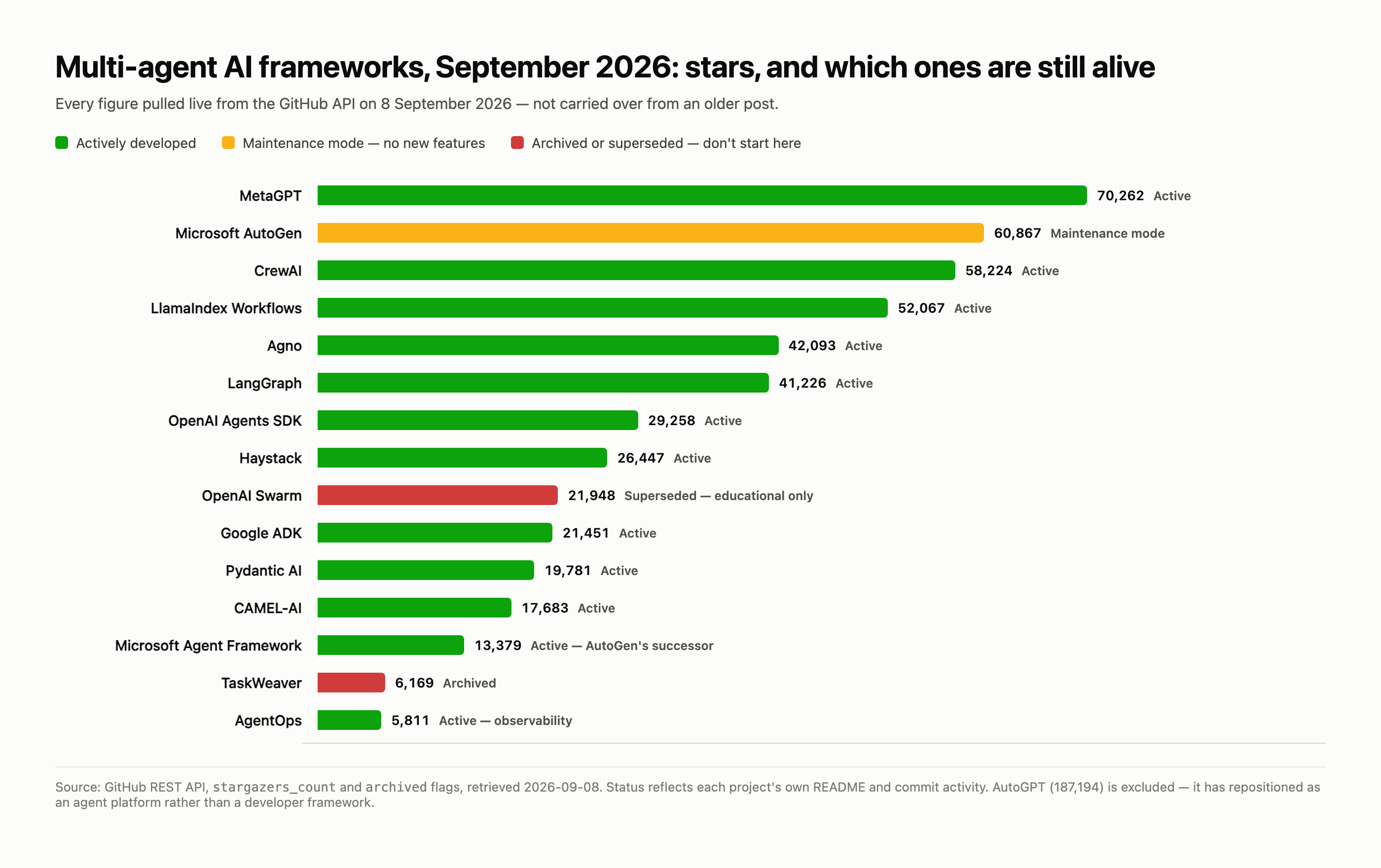
Most of the framework roundups on this topic are quoting GitHub star counts that are three to five times too low, still recommend a project Microsoft moved into maintenance mode, and point people at a repository that’s been archived. I know, because this morning I pulled every number in this post from the GitHub API instead of copying it from somebody else’s article.

That sounds like a small thing. It isn’t. If you’re choosing what to build your company’s agent stack on, the difference between “actively developed” and “archived, community-managed, no new features” is the difference between a two-year investment and a rewrite.

So this is the honest version, checked on 8 September 2026 by someone who has to live with these decisions rather than just write about them.

How I picked these

I’ll be straight about my criteria, because most listicles won’t tell you theirs.

Is it alive? Not stars. Stars are a popularity lag indicator and they never go down, which makes them close to useless for judging whether a project is healthy. I checked the archived flag, the date of the last commit, and what each project’s own README says about its status. Two of the most-recommended frameworks failed this test.

Would I put it in front of a client? I’ve spent 20 years shipping software into large organizations. A framework that’s delightful in a notebook and undebuggable at 2 a.m. is not a framework I can recommend to somebody whose quarter depends on it.

Does it solve a real coordination problem? Plenty of projects are a thin wrapper on a model API with the word “agent” in the README. The ones below actually do something about state, handoffs, or failure.

I also want to be honest about my own position. My production fleet doesn’t run on any of these. It runs on Google’s A2A protocol with direct calls to the model APIs, because when I built it the framework options were less mature than they are now. Take that as context rather than advice: I’ve already paid for the parts they abstract away, so I know exactly what each one is saving you.

Bar chart of 15 multi-agent frameworks by GitHub stars, color-coded by project health: actively developed, maintenance mode, or archived

The twelve worth your time

1. LangGraph (41,226 stars)

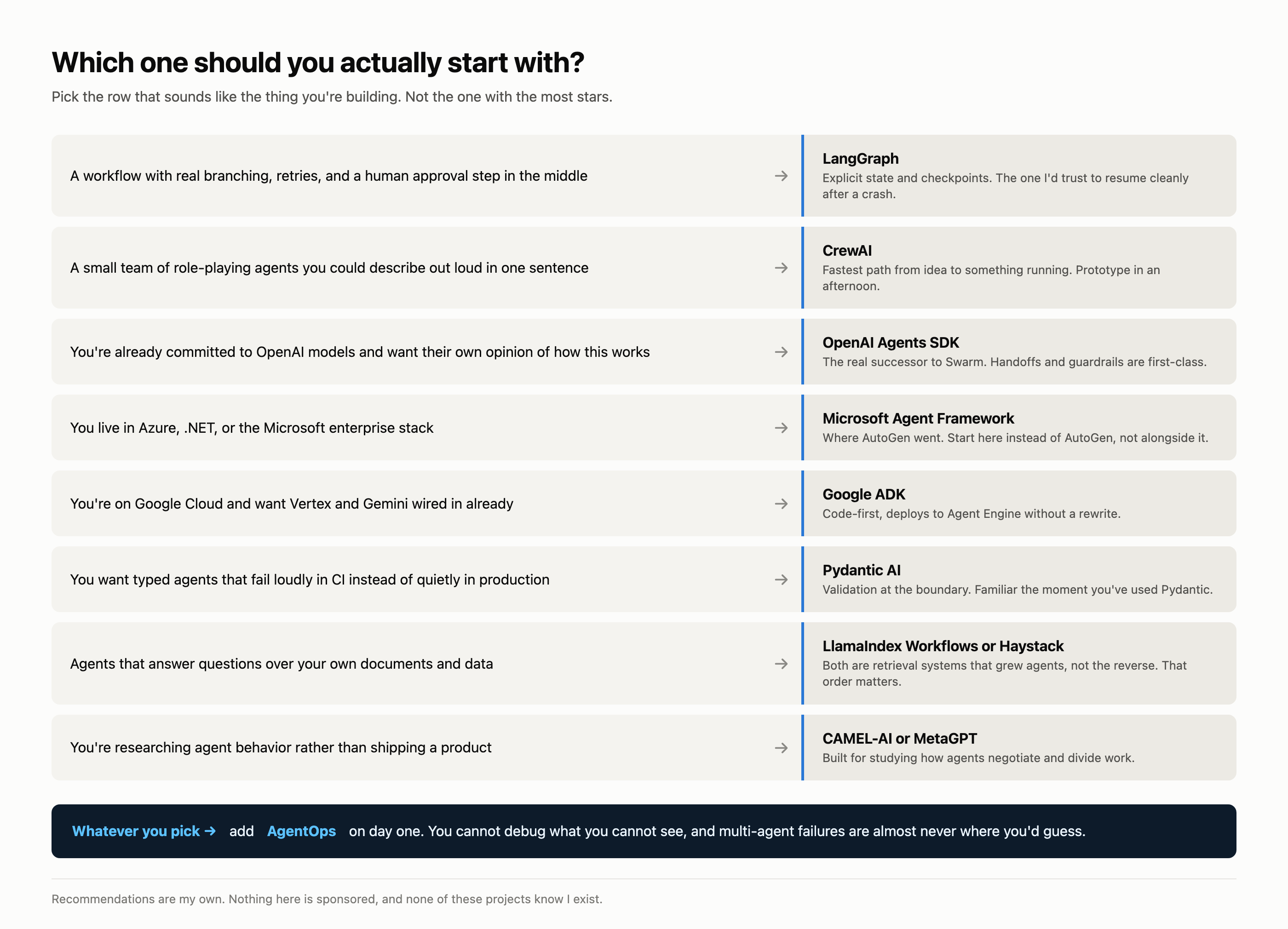
The one I’d reach for when the work has to survive contact with reality. LangGraph models your system as a graph with explicit state, which sounds academic until the first time a run dies halfway through and you need to resume it without redoing the expensive half.

Its checkpointing is the feature nobody appreciates until they need it. Human-in-the-loop approval steps are a first-class concept rather than something you bolt on. The tradeoff is that you have to think about your state shape up front, and people coming from simpler tools find that annoying for about a week.

Best for: long-running workflows, approval gates, anything where a crash can’t mean starting over.

2. CrewAI (58,224 stars)

The fastest way to get from an idea to something running. You describe agents as roles with goals, hand them tasks, and it works. You can have a usable prototype running in a morning.

The role metaphor is also its ceiling. It maps beautifully onto “a researcher, a writer, and an editor” and it strains when your actual problem doesn’t decompose into job titles. Note that the repository moved to crewAIInc/crewAI, so older links redirect.

Best for: prototypes, and production systems whose shape really is a small team with clear jobs.

3. OpenAI Agents SDK (29,258 stars)

This is the real successor to Swarm, and if you read an article recommending Swarm, that article is out of date. Swarm was always labeled educational. This is the production version of the same ideas: handoffs between agents, guardrails, and tracing that actually helps.

If your stack is already committed to OpenAI models, starting anywhere else costs you integration work for benefits you may not need.

Best for: OpenAI-native builds that want handoffs and guardrails without much ceremony.

4. Microsoft Agent Framework (13,379 stars)

The lowest star count in this section and the one I’d bet on hardest if you’re an enterprise. This is where AutoGen went. Microsoft has stated that AutoGen is in maintenance mode and that new users should start here, with a documented migration path from AutoGen and a commitment to long-term support.

Thirteen thousand stars looks unimpressive next to AutoGen’s sixty thousand. Those sixty thousand stars are a monument to a project that stopped taking new features. Start where the work is happening.

Best for: Azure, .NET, and anywhere procurement asks who supports this.

5. Google ADK (21,451 stars)

Google’s Agent Development Kit is code-first, which I appreciate. It deploys to Agent Engine without you rewriting your agent for production, and Gemini and Vertex are wired in rather than adapted.

Same logic as the Microsoft entry. If your data already lives in Google Cloud, the framework that shortens the distance to your data usually wins over the one with a nicer API.

Best for: Google Cloud shops, and teams who want evaluation built in rather than added later.

6. Pydantic AI (19,781 stars)

The one I’d point a team to after they’ve been burned. Pydantic AI puts type validation at the boundary of every agent, which means malformed model output fails in your test suite instead of quietly corrupting something three steps downstream.

If your team already uses Pydantic, and in Python most do, the learning curve is close to zero. This is the least glamorous framework on the list and the one most likely to save you a bad week.

Best for: teams that want agents to fail loudly and early.

7. Agno (42,093 stars)

Agno has grown quickly by being fast and staying out of your way. It leans hard on performance and low overhead per agent, and it bundles memory and knowledge without requiring you to assemble four libraries first.

I’d call it the pragmatist’s pick. Less opinionated than LangGraph, more structured than rolling your own.

Best for: many lightweight agents where per-agent overhead actually shows up in your bill.

8. LlamaIndex Workflows (52,067 stars)

If your agents mostly answer questions about your own documents, start here rather than at a general orchestration framework. LlamaIndex was a retrieval system that grew agents. The ordering matters: retrieval is the hard part of that problem and it’s the part LlamaIndex has been solving longest.

Workflows added event-driven orchestration on top, so you’re no longer choosing between good retrieval and decent coordination.

Best for: document-heavy and knowledge-base agents.

9. Haystack (26,447 stars)

deepset’s framework, and the most production-minded of the retrieval-first options. Pipelines are explicit and inspectable, which makes Haystack pleasant to operate and slightly less pleasant to write. That’s a trade I’ll take on anything that has to run unattended.

Best for: search and question-answering systems that need to be auditable.

10. CAMEL-AI (17,683 stars)

Built to study how agents behave when they talk to each other, and very good at it. If you’re exploring negotiation, role-play, or emergent behavior between agents rather than shipping a product next quarter, this is a research instrument rather than a factory tool.

Best for: research, simulation, and agent-behavior work.

11. MetaGPT (70,262 stars)

The most-starred framework here, built on the idea of simulating a software company: a product manager agent, an architect, engineers. When the metaphor fits, the structured output is impressive.

One caution I’d give honestly: its last significant commit activity is older than most of this list. High stars, slowing pace. Watch it before you commit a roadmap to it.

Best for: code generation and structured multi-role output, with your eyes open about velocity.

12. AgentOps (5,811 stars)

Not an orchestration framework, and the one I’d argue hardest for you to install anyway. AgentOps is observability for agents: what each one did, what it cost, where it went wrong.

I put it last on the list and first in the build order. Every painful failure I’ve had in production was invisible before it was obvious.

Best for: every project on this page.

Decision guide matching eight common build situations to a recommended framework, with a note to add AgentOps on day one

Side by side

Framework Stars Status Learning curve Where it wins
MetaGPT 70,262 Active, slowing Medium Structured code generation
CrewAI 58,224 Active Low Speed to first prototype
LlamaIndex Workflows 52,067 Active Medium Retrieval-heavy agents
Agno 42,093 Active Low Low per-agent overhead
LangGraph 41,226 Active Medium-high Stateful, resumable workflows
OpenAI Agents SDK 29,258 Active Low OpenAI-native handoffs
Haystack 26,447 Active Medium Auditable search pipelines
Google ADK 21,451 Active Medium Google Cloud and Vertex
Pydantic AI 19,781 Active Low Type safety at the boundary
CAMEL-AI 17,683 Active Medium Agent-behavior research
Microsoft Agent Framework 13,379 Active Medium Enterprise and .NET support
AgentOps 5,811 Active Low Observability for all of the above

The three I’d avoid, and why

This is the section the other roundups don’t write, and it’s the one that will save you the most time.

Microsoft AutoGen (60,867 stars) is in maintenance mode. Its own README carries the notice: no new features, community-managed going forward, new users should start with Microsoft Agent Framework. Those sixty thousand stars will keep it at the top of search results and near the top of every listicle for another year. Don’t start a new project on it. If you already have one, Microsoft publishes a migration guide.

OpenAI Swarm (21,948 stars) was never meant for production. OpenAI describes it in its own words as an educational framework exploring lightweight multi-agent orchestration. It did its job, the ideas graduated into the Agents SDK, and that’s where you should be. Any 2026 article recommending Swarm for production was written by someone who didn’t check.

TaskWeaver (6,169 stars) is archived. The repository is flagged archived on GitHub, which means read-only, no fixes, no security patches. I still find it in “top frameworks for 2026” lists, sometimes recommended for data-intensive work. Building on an archived repository is taking on maintenance of a codebase you didn’t write and don’t understand.

Three things running these in production taught me

The framework you pick matters less than most people writing about frameworks want to admit. Here’s what actually decided whether my systems worked.

Your failure alarms matter more than your architecture. One of my pipelines stopped publishing for 47 days and I had no idea. A model I depended on had been quietly deprecated, my system kept calling something that no longer existed, and the alerting was pointed at a dead address. I found it by accident. An autonomous system without working alarms isn’t autonomous, it’s unsupervised, and no framework on this page fixes that for you.

Graceful degradation is often just shipping broken work quietly. My image pipeline was written to fall back through several providers and, if all of them failed, to publish anyway with a warning in the log. That’s textbook resilient design. In practice it meant articles going out with no image at all while the system reported success. Decide deliberately which failures should stop the line, because “keep going” is a choice with consequences.

A gate that fails open is not a gate. I had a duplicate-detection check that had been silently passing everything since the day it shipped, because of a bug in how it built its query. It ran, it logged, it reported clean, and it was doing nothing. It never crashed, so nothing ever told me. Now anything that guards quality gets a test that proves it can actually say no.

None of those three lessons are about LangGraph or CrewAI. They’re about operating autonomous systems, and they’ll be true whichever row of the table you pick.

Where this is going

The interesting movement in 2026 is happening underneath the frameworks, in the protocols. A2A for agent-to-agent communication and MCP for tool access are both being adopted across frameworks that otherwise compete, which points at a future where your orchestration choice stops being a lock-in decision.

That’s good news for anyone making this call today. Pick the one that fits the work in front of you, keep your business logic out of the framework’s abstractions where you can, and accept that you’ll probably migrate once. Everyone does.

Sources

Every star count and status in this post came from the GitHub REST API on 8 September 2026, using the stargazers_count and archived fields, plus each project’s own README for maintenance status.

Numbers move. If you’re reading this months from now, check them yourself before you decide anything. That’s the whole point of this post.

A note on how this gets made: I run my own content pipeline, the same kind of system I build for clients. It drafts, I edit and fact-check every line, and I sign it. Claiming expertise in production AI and then hiding that I use it would be a strange way to make the point.

— Juan
Balancing AI Regulation: A Path to Innovation

We’re at a pivotal moment. Decisions made today will shape our future with AI.

Artificial Intelligence is no longer a distant concept; it’s here, influencing everything from healthcare to finance. But with its rapid advancement comes a critical question: How do we harness its potential without unleashing unintended consequences?

Why is this crucial?

Because over-regulation could stifle innovation, preventing breakthroughs that could benefit society. Conversely, insufficient regulation might lead to ethical pitfalls, privacy breaches, and a loss of public trust in technology.

So, what’s the path forward?

A balanced approach to AI regulation.

Here’s how we can achieve it:

• Inclusive Dialogue: Engage technologists, policymakers, and the public in conversations about AI’s role.

• Adaptive Policies: Create flexible regulations that can evolve with technological advancements.

• Ethical Frameworks: Implement guidelines that prioritize transparency, fairness, and accountability.

• Investment in Education: Equip the workforce with the skills needed to thrive alongside AI.

By finding the middle ground, we can foster innovation while safeguarding societal values.

Let’s work together to shape an AI-powered future that’s both exciting and responsible.

What are your thoughts on achieving this balance?

Riding the Wave of AI Progress: The Next Big Thing in Large Language Models (LLMs)

Let’s embark on a thrilling journey as we delve into the world of advanced artificial intelligence (AI) and its extraordinary spin-off, Large Language Models (LLMs). This blog post will uncover the revolutionary trends, shedding light on how the “El Dorado” of AI innovation is influencing our lives.

Keywords: AI, LLM, Machine Learning, GPT-4, Future of AI, AI Trends, AI Innovations, NLP, Deep Learning, AI and Society, AI Breakthroughs

The Dawn of a New AI Era

Artificial Intelligence isn’t just a buzzword anymore; it’s an integral part of our everyday lives, changing the way we work, communicate, and perceive the world around us. From Siri’s morning greetings to personalized Netflix recommendations and self-driving Teslas, AI has profoundly transformed our reality.

In this era of relentless advancement, one particular AI innovation has been garnering substantial attention: Large Language Models (LLMs). The evolution from OpenAI’s GPT-1 to the groundbreaking GPT-4 architecture has been nothing short of an AI roller-coaster ride.

Demystifying LLMs: A New Level of AI Interaction

LLMs, such as the famous GPT-4, are the new rockstars of the AI world. Their ability to understand and generate human-like text is unprecedented. These models are trained on a vast corpus of internet text and can write essays, poems, summarize articles, translate languages, and even code software!

And they’re getting better. The latest LLMs have been trained to understand the context more precisely and generate more coherent and contextually relevant responses. They can even simulate multi-turn conversations, answering follow-up questions accurately.

The GPT-4 Revolution

Following its predecessors’ (GPT-3) success, GPT-4 is now changing the AI game with its increased capacity and enhanced performance. It’s like stepping into a sci-fi reality where AI can write novels, generate insightful reports, tutor in multiple subjects, and much more.

GPT-4 understands the nuances of language better than any model before it. It demonstrates improved efficiency in handling ambiguity, grasping complex sentence structures, and identifying implicit context, hence bringing us one step closer to general artificial intelligence.

The AI Impact: Society & Beyond

The influence of advanced AI and LLMs extends beyond personal assistants and content generation. It’s shaping industries, healthcare, education, and even our social dynamics. AI-powered LLMs like GPT-4 are being leveraged for mental health apps, teaching tools, customer service, and many other applications.

In this era of rapid digital transformation, mastering AI literacy will become a necessity rather than a novelty. We need to embrace AI as a tool for progress and work towards its ethical and fair usage.

AI: The Road Ahead

Despite the breakthroughs, AI and LLMs are still young in their journey. Challenges in terms of biases, security, and data privacy exist. However, the vibrant AI community continues to innovate and make strides toward creating robust and ethical AI systems.

The age of AI is here. Let’s ride the wave, one algorithm at a time. Stay tuned with us as we continue to explore the transformative world of AI and bring you the latest and most exciting AI trends and innovations.

Please share this blog post if you’ve found it insightful. It’s time to spark more conversations about the future of AI!

#AI #LLM #MachineLearning #GPT4 #FutureOfAI #AITrends #AIInnovations #NLP #DeepLearning #AIandSociety #AIBreakthroughs

Blog at WordPress.com.