Which Industries Are Actually Being Transformed by AI? The Real Number Is Smaller Than You’ve Been Told

A grid of two hundred squares with forty lit in gold, showing the twenty percent of US businesses that report using AI

As of May 2026, 19.8% of US businesses reported using AI in any part of their operations. That figure comes from the Census Bureau’s Business Trends and Outlook Survey, which asks a nationally representative sample of firms every two weeks. Not a vendor survey. Not a consulting projection. The government asking businesses what they actually do.

Roughly four in five American businesses are not using AI at all.

I want to sit with that number for a moment, because it is very hard to reconcile with the articles you have been reading. Including, I should say, one on a site I run, which lists eight industries “completely transformed by AI” and is the reason I went looking for real data in the first place.

Why this one is here

This blog is about strategy, and strategy is mostly about seeing the situation accurately before you commit money to it.

Building AI systems is my day job. At Omnilogic Labs we design and run AI automation for banks and enterprises. Doing that work continuously, for clients who have to justify the spend internally, gives me a fairly unromantic view of where this technology actually is. I sell AI for a living and I am telling you the adoption numbers are far lower than the coverage suggests. That should probably carry some weight.

The gap between the headlines and the survey data is not a curiosity. It is a strategic opening, and I will come back to that at the end.

What “AI adoption” actually means here

Worth being precise, because this is where most statistics in this area fall apart.

The Census Bureau asks businesses whether they used AI in producing goods or services in the last two weeks. In November 2025 they widened the question from production-specific uses to AI used in any business function, which made the number go up and made it more honest.

So 19.8% is a generous measure. It counts a marketing team using a chatbot to draft copy. It counts one department running one tool. It does not require the company to have changed anything structural.

Even on that generous definition, four out of five say no.

Compare that to the framing in most coverage, where entire sectors have been “completely transformed.” Both things cannot be true.
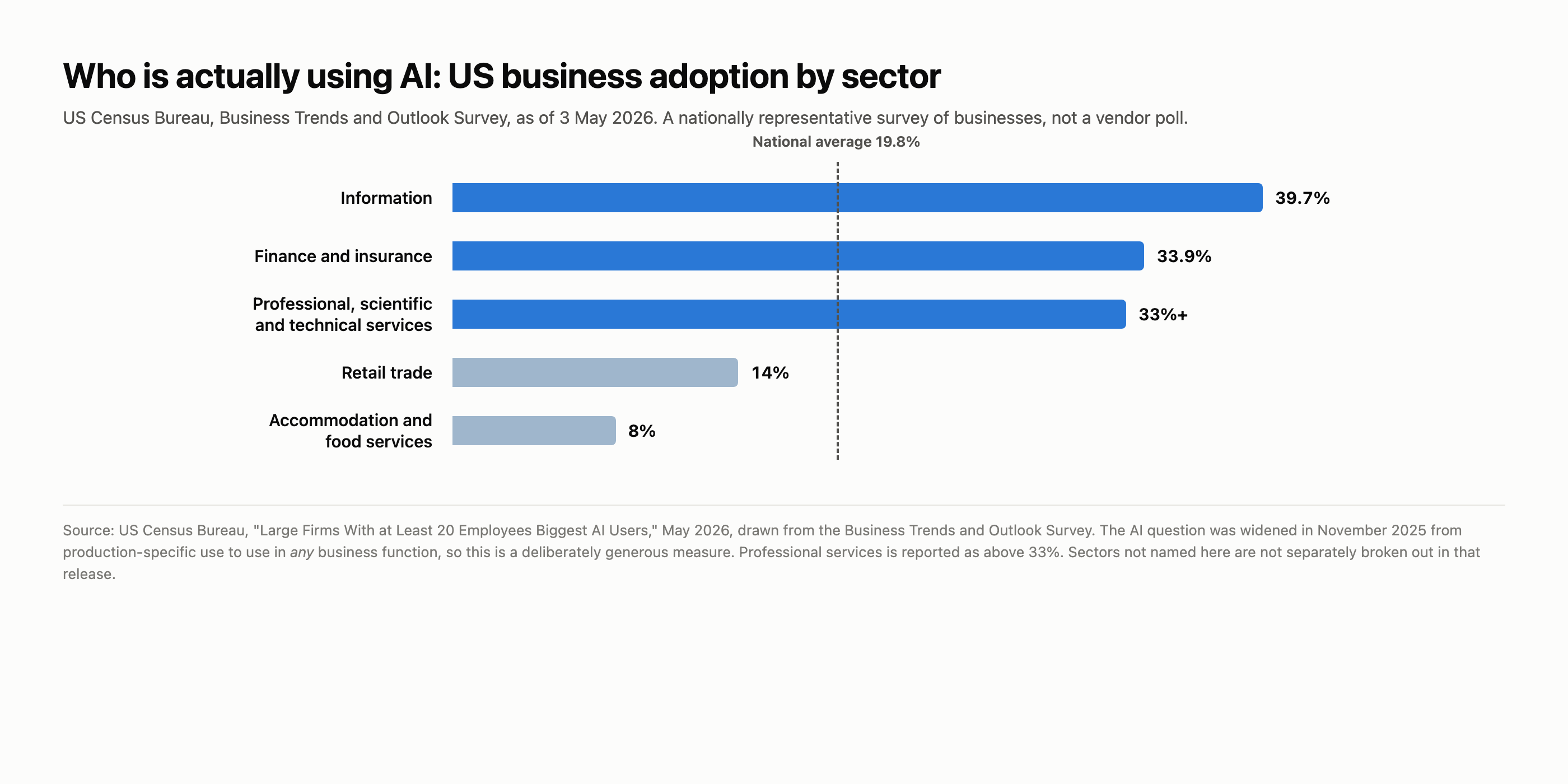
Bar chart of US AI adoption by industry sector from Census BTOS data, showing Information at 39.7% and Finance at 33.9% against a 19.8% national average

Where adoption is genuinely high

Two sectors stand clearly above everyone else, and they have something in common.

Information: 39.7%. Software, media, telecoms, publishing. Roughly double the national rate.

Finance and insurance: 33.9%. Banks, insurers, asset managers. Also well above.

The pattern is not that these industries are more forward-thinking. It’s that their raw material is already digital. An insurer’s product is a document and a risk model. A software company’s product is text. There is no physical step to re-engineer, no sensor to install, no union to consult. The distance between “we should try this” and “it is running” is short.

That is the actual predictor of AI adoption, and it is more useful than any list of industries. Ask how much of your core work already exists as text, code, or structured data. That fraction is roughly the fraction of your business AI can touch this year.

Where it is much lower than you have been told

Retail trade sits around 14%, below the national average.

I want to flag that specifically, because retail and e-commerce appear near the top of nearly every “industries transformed by AI” list, including the one I am rewriting. Recommendation engines have been in the press for a decade. The survey says most retailers are not using AI in any business function.

Accommodation and food services is around 8%, the lowest of the major sectors. Also frequently described as being revolutionized.

Both make sense once you drop the assumption that press coverage tracks reality. These are low-margin businesses with physical operations, seasonal labor, and thin technical staff. The barrier is not skepticism about AI. It is that nobody in the building has time to implement anything.

What about healthcare, manufacturing, and the rest of the usual list?

The standard “industries transformed by AI” article names roughly the same eight every time: healthcare, financial services, retail, manufacturing, transportation and logistics, energy, legal, and agriculture. Two of those hold up against the survey data. Most do not, and the reason is consistent.

Legal and professional services hold up. Professional, scientific and technical services report adoption above 33%, in the same band as finance. That is entirely predictable once you accept the digital-raw-material thesis. Legal work is reading documents and producing documents. There is no physical process in the way.

Healthcare, manufacturing, energy, transportation and agriculture are physical-first. Their core work involves patients, machines, turbines, trucks and soil. AI can help around the edges of all of them, and there are real deployments worth reading about. But “completely transformed” is not a description of an industry where the central activity happens in the physical world and the regulatory approval cycle is measured in years.

I would put it this way. The genuinely exciting healthcare AI stories are about diagnostic imaging, which is a text-and-pixels problem sitting inside a physical industry. That is the pattern. AI is arriving in the document-shaped parts of physical industries, not in the industries as a whole. An article that names a sector rather than a function is making a claim it cannot support.

A note on what I can and cannot tell you here. The Census release breaks out some sectors by name and not others, so I am not going to give you a precise figure for healthcare or manufacturing, because I do not have one I can point you to. Most articles in this category would simply make one up. If you need those numbers, the BTOS data is public and you can cut it yourself.

The divide that matters more than industry

Sector turns out to be less predictive than size.

Firm size Using AI
250+ employees 37%
100–249 employees 32%
Fewer than 20 employees Under 20%

A large company is roughly twice as likely to be using AI as a small one, regardless of what business it is in. That is a resourcing story: large firms have people whose job includes evaluating tools, and budget that does not require the owner’s personal approval.

This is the single most important line in the data for most readers of this blog. If you run a business with fewer than 20 people, you are not behind your industry. You are exactly where four out of five of your peers are. What you are behind is the largest firms in your market, and that gap is widening.
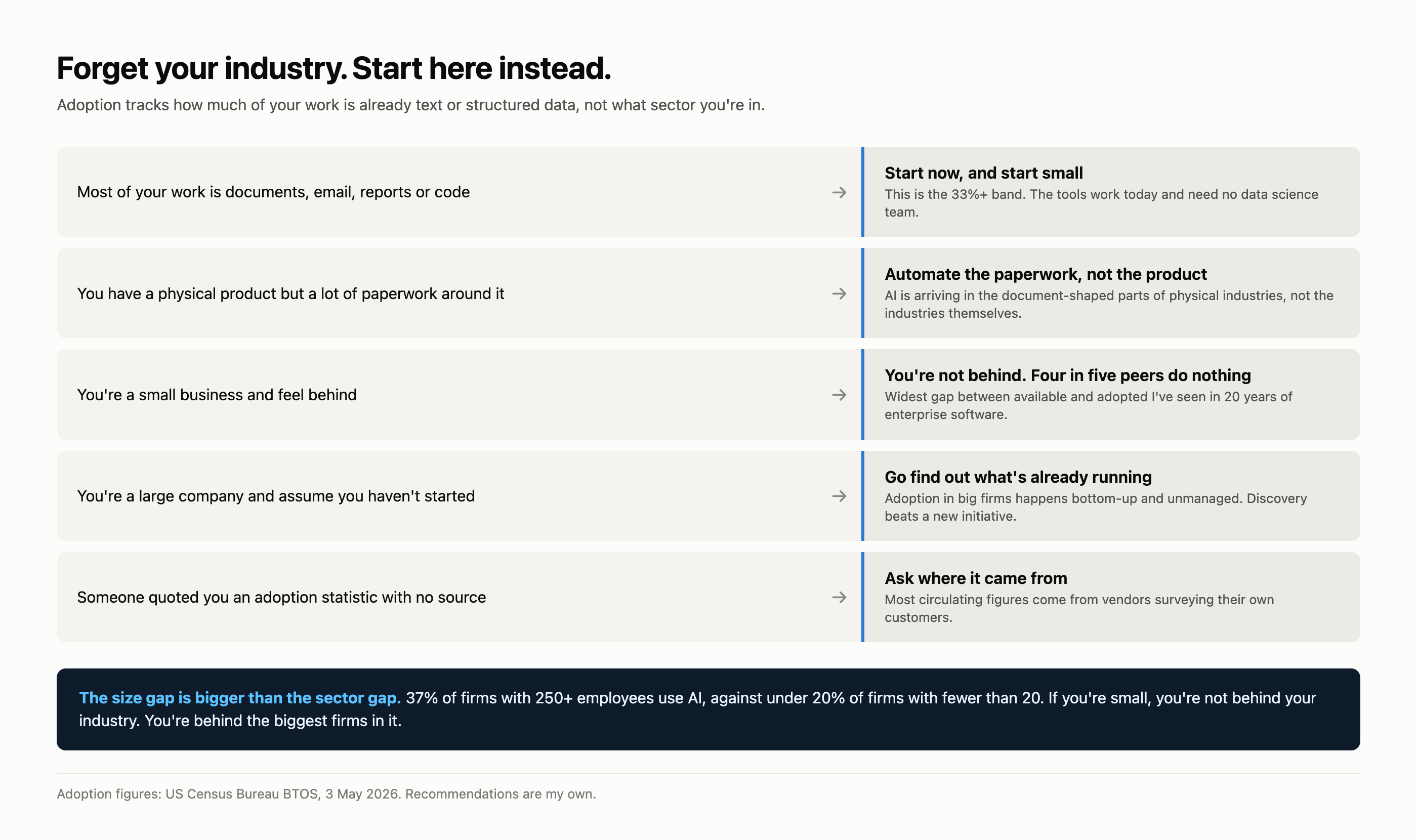
Decision guide mapping business situations to a recommended AI starting point, based on how much of the work is already digital

Why the coverage and the data disagree so badly

Four reasons, and they are worth recognizing because you will keep encountering all of them.

Vendor surveys are not neutral. Most adoption statistics in circulation come from companies selling AI, surveying their own customers or an audience that opted into an AI newsletter. That population is not the economy.

“Transformation” has no threshold. A sector gets called transformed when a few visible companies do something interesting. Nobody defines what share of firms must be doing what before the word applies.

The exciting cases are unrepresentative. A hospital piloting diagnostic imaging AI is a genuinely good story. It is also one hospital, and the article rarely mentions what share of hospitals are doing anything comparable.

Articles cite articles. This is the mechanism that keeps stale claims alive. The retail example is instructive: the claim that retail is being reshaped by AI has been repeated so many times that it now requires effort to notice the survey data says otherwise.

What I would actually tell a client

Stop asking whether your industry is being transformed. Ask what fraction of your own work already exists as text or structured data, because that is what determines whether AI can help you this year. A law firm and a software company have very different reputations and very similar answers.

If you are small, the opportunity is unusually good right now. Four in five of your competitors are doing nothing. The tools are cheap and no longer require a data science team. This is the widest gap between “available” and “adopted” I have seen in twenty years of enterprise software, and gaps like this close.

If you are large, your risk is different. You are probably already using AI somewhere, without a clear picture of where, by whom, or on what data. Adoption in most large companies happened bottom-up and unmanaged. Finding out what is already running is usually more urgent than starting something new.

Be suspicious of any number without a source. Including the ones in this post, which is why every figure here links to the survey it came from. If a statistic about AI adoption has no citation you can click, treat it as marketing.

The part that matters

The most useful thing in this data is not which sectors are ahead. It is the size of the gap between what is possible and what is actually happening.

Nearly everything written about AI describes the frontier: the best model, the most advanced deployment, the company doing something remarkable. Meanwhile four out of five businesses have not started, and the most common reason is not fear or philosophy. It is that nobody had time.

That is a slower and less exciting story than transformation. It is also where essentially all of the remaining value is.

Sources

  • US Census Bureau, “Large Firms With at Least 20 Employees Biggest AI Users” (May 2026), the source for every adoption figure in this post: census.gov
  • Business Trends and Outlook Survey, the underlying instrument: census.gov/hfp/btos
  • Census working paper, “The Microstructure of AI Diffusion: Evidence from Firms, Business Functions, and Worker Tasks”: census.gov
  • Federal Reserve, “Monitoring AI Adoption in the U.S. Economy” (April 2026): federalreserve.gov

The Census Bureau widened its AI question in November 2025 from production-specific use to any business function, so figures before and after that change are not directly comparable. All figures above are as of 3 May 2026.

A note on how this gets made: I run my own content pipeline, the same kind of system I build for clients. It drafts, I edit and fact-check every line, and I sign it. Claiming expertise in production AI and then hiding that I use it would be a strange way to make the point.

— Juan
AI Presentation Tools in 2026: What Survived, and What Most Guides Still Get Wrong

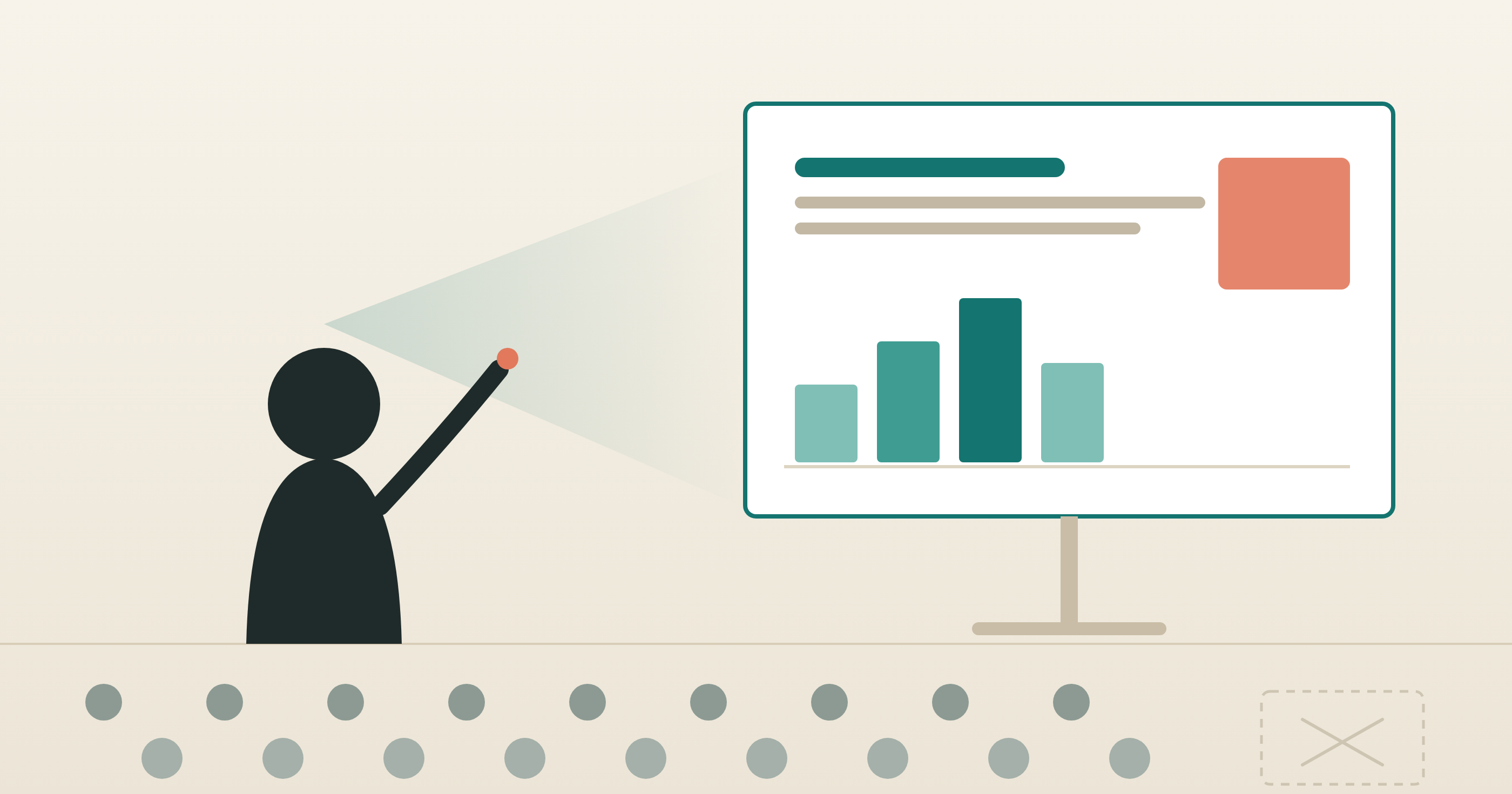
A speaker presenting a slide to a seated audience, with one retired deck faded and crossed out at the edge of the room

A lot of the “best AI presentation tools” articles you’ll find right now recommend Tome. Tome shut its presentation product down on 30 April 2025, and decks that users hadn’t exported were deleted. Several of those articles were published well after that date, including one on a site I run, which is part of why I’m writing this.

That’s the useful thing about this category. It has been through a full hype cycle already, and the wreckage tells you more about choosing software than any feature comparison.

Why this one is here

This blog is mostly about strategy. Presentation software sounds like the least strategic topic imaginable, right up until you realize how much of your company’s thinking is stored inside it.

Building AI systems is my day job. At Omnilogic Labs we design and run AI automation for banks and enterprises, and doing that work repeatedly for clients teaches you something that no product review covers: which vendors are still going to be there when you need to open the file again. That question has a low profile and a high cost. This post is mostly about that.

What an AI presentation tool actually does

Take the plain version first, because the marketing obscures it.

You give the tool your content, either by typing a prompt or pasting in a document. It does two separate things with that. It decides what goes on each slide, breaking your material into a sequence of ideas. Then it lays those ideas out, choosing type sizes, spacing, and images so the result looks deliberate rather than assembled.

The second part is the older and more reliable technology. Tools have been enforcing design rules for years. The genuinely new part is the first one, where a language model reads your content and decides what the story is.

That distinction matters when you’re choosing. Some of these products are design engines with AI attached. Others are language models with a slide renderer attached. They fail in different ways, and which failure you can tolerate should drive your choice.

The cautionary tale worth more than the feature list

Tome raised $81.6 million at a $300 million valuation and reached roughly 20 million users in about 18 months. By the standards of consumer AI, it won.

Its annual recurring revenue stayed under $4 million.

People loved it and would not pay for it. In October 2024 the company announced it was leaving presentations. It confirmed the sunset in March 2025 and closed the product on 30 April 2025. The founding team went to build a sales intelligence company called Lightfield. The Tome brand was picked up by AngelList. Users who had not exported their decks lost them.

I keep coming back to this story with clients because it is not really about AI. It is about where your work lives. A presentation tool holds your strategy, your pitch, your board narrative. If the company holding it has twenty million delighted users and no revenue, you are not the customer, you are the growth metric, and growth metrics get switched off.

The practical rule that falls out of this: before you standardize on any of these, check that it exports cleanly to PowerPoint or PDF, and then actually export something. Not as a migration plan. As a monthly habit. A tool that makes export awkward is telling you something about its business model.

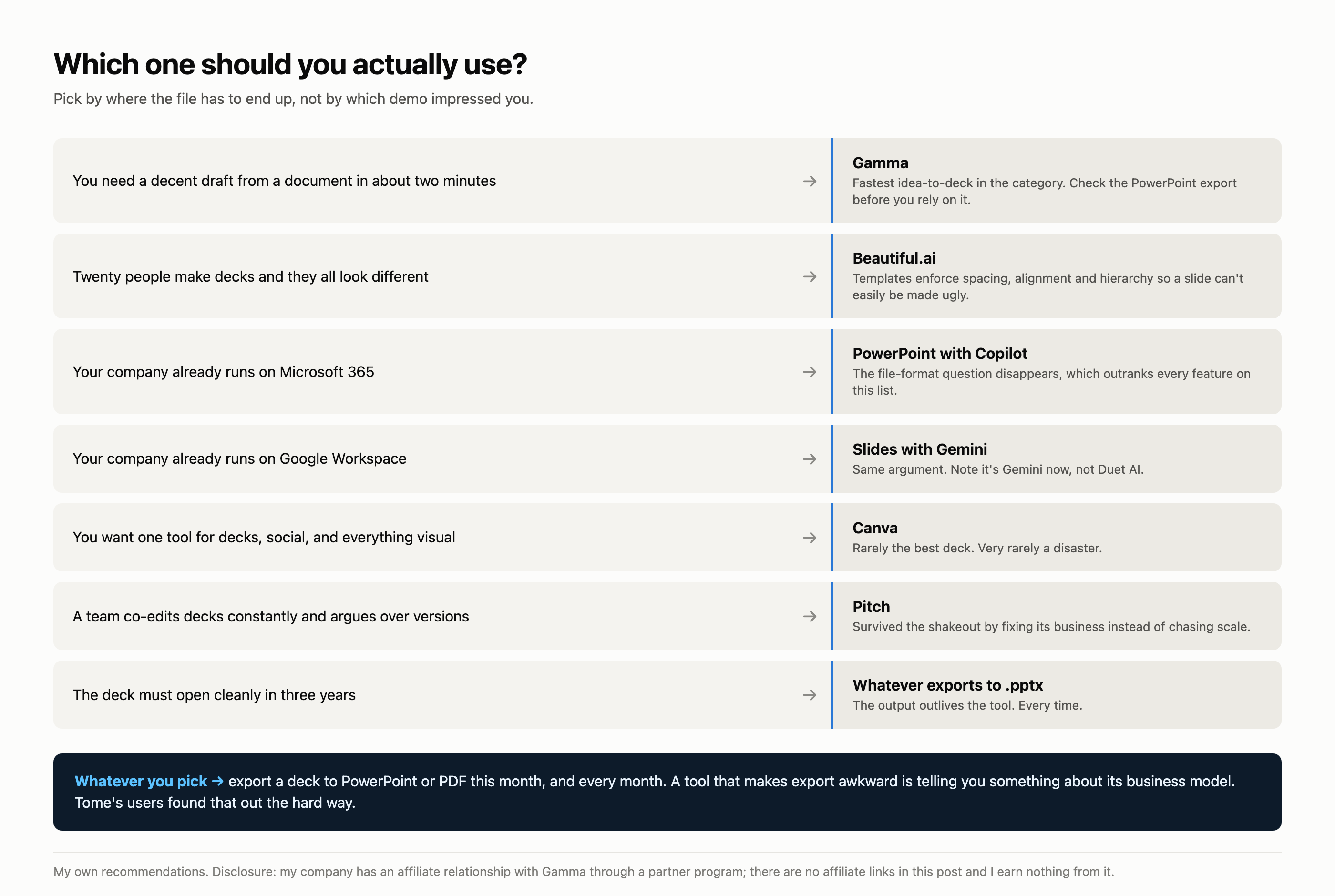
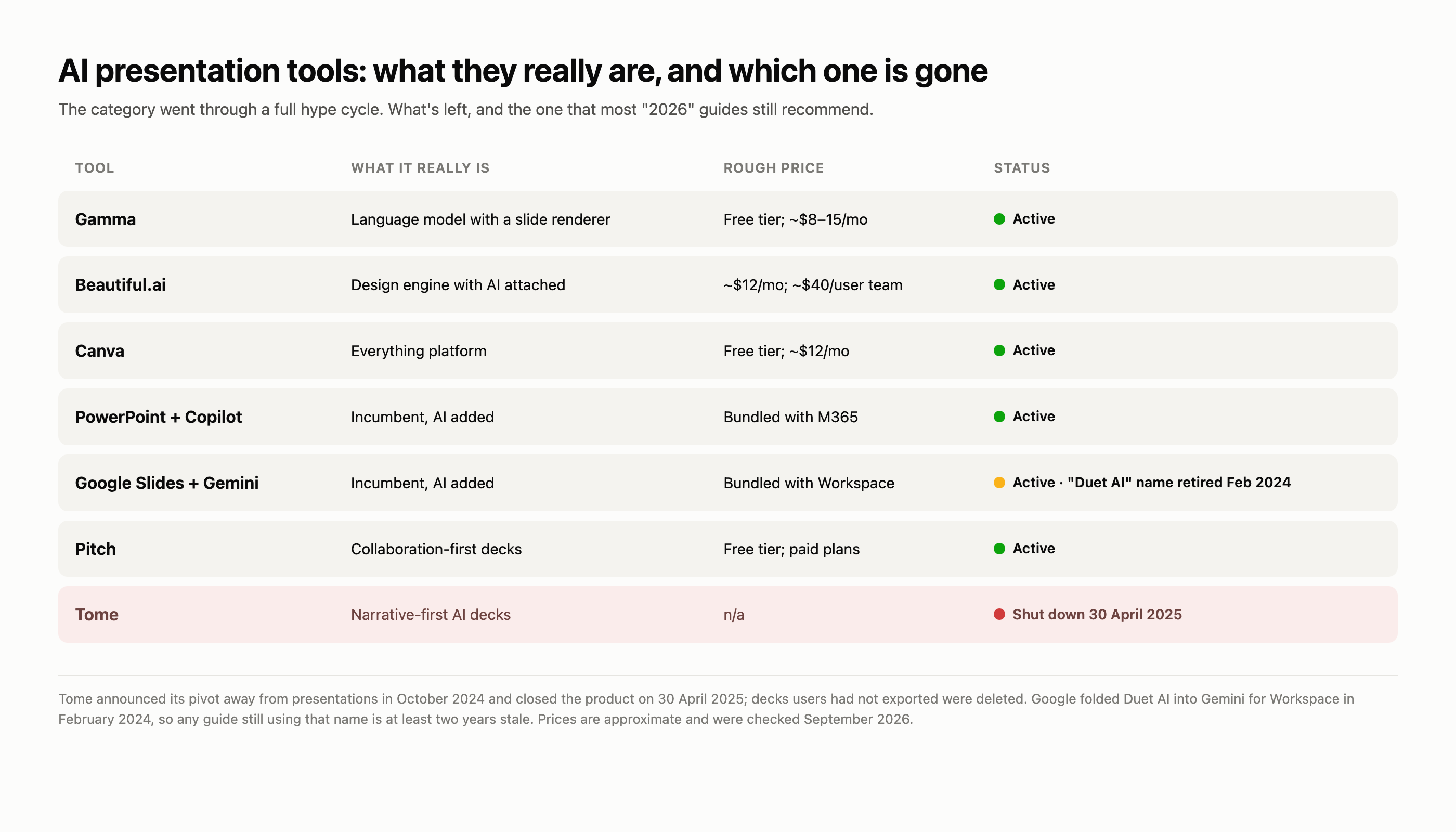
Comparison of current AI presentation tools by approach, pricing tier, and export quality, with Tome marked as discontinued

What’s actually worth using

Gamma is the one most people mean when they say AI presentation tool. You give it a prompt or a document and it produces something coherent fast, in a scrolling card format that also works as a webpage. Free tier with credits, Plus around $8 a month billed annually, Pro around $15. It added an image generation product, Gamma Imagine, in March 2026. Its weakness is that its native format is not really a slide deck, so PowerPoint export can need cleanup.

Beautiful.ai is the design engine rather than the language model. Its templates enforce spacing, alignment and hierarchy so that a slide cannot easily be made ugly. Around $12 a month for an individual, roughly $40 per user per month for teams with shared brand controls. Choose it when consistency across a team matters more than speed for one person.

Canva is the pragmatic answer for most organizations, and it is boring in the way that infrastructure should be boring. It has AI features, an enormous asset library, everyone already knows it, and Pro is around $12 a month billed annually. It rarely produces the best deck. It very rarely produces a disaster.

PowerPoint with Copilot is what you should look at first if your company is already on Microsoft 365, purely because the file format question disappears. Your output is a .pptx that everyone can open, edit, and will still be able to open in ten years.

Google Slides with Gemini is the same argument for Google Workspace companies. Note the name: the Duet AI branding that older articles use was retired in February 2024 when Google folded those features into Gemini. If a guide is still calling it Duet AI, that tells you when it was really written.

Pitch deserves a mention because it survived the shakeout by fixing its business rather than chasing scale. After restructuring in January 2024 it runs profitably. Strong on collaboration and version control for teams that live in decks.

Decision guide matching common presentation situations to a recommended tool, including when to just use PowerPoint

Side by side

Tool What it really is Rough price Best when
Gamma Language model with a renderer Free tier; ~$8-15/mo You want a good draft in two minutes
Beautiful.ai Design engine with AI ~$12/mo; ~$40/user team Team consistency matters most
Canva Everything platform Free tier; ~$12/mo You want one tool for all visual work
PowerPoint + Copilot Incumbent with AI added Bundled with M365 You’re already Microsoft and need .pptx
Google Slides + Gemini Incumbent with AI added Bundled with Workspace You’re already Google
Pitch Collaboration-first decks Free tier; paid plans Teams co-editing decks constantly
Tome n/a n/a Discontinued 30 April 2025

How to tell a stale guide from a current one

This applies well beyond presentation software, so it’s worth spelling out. I use four tells, and they take about thirty seconds.

Does it recommend something that no longer exists? Tome is the giveaway in this category. In AI video it’s Sora. In agent frameworks it’s AutoGen and TaskWeaver. Every category has one, and the presence of a dead product means the article was assembled from other articles rather than from use.

Does it use retired brand names? “Duet AI” was folded into Gemini in February 2024. Anything still using that name is at minimum two years behind, no matter what year is in the title. Product names are a reliable timestamp because writers copy them without checking.

Are the numbers suspiciously round and uncited? “Reduces deck creation time by 73 percent” is the kind of figure that appears in these articles attached to no study anybody can find. If a statistic has no source you can click, assume it was invented, because quite often it was.

Does it include quotes from experts you cannot find? This is the one I’d flag hardest. A named person at a recognizable company, saying something conveniently supportive, who returns no search results. I’ve found these in articles across this whole category, and once you start looking you cannot stop seeing them.

None of this requires expertise. It requires clicking two links, which is roughly two more than most published roundups have done.

What I’d tell a client

Pick for the file format, not the demo. The output of this work outlives the tool that made it. If your deck has to be opened by a client, a regulator, or a colleague in three years, the format question outranks every feature on the list.

Let the AI do the first draft and nothing else. These tools are genuinely good at getting you from an empty page to a rough structure, which is the part people procrastinate over. They are not good at judgment about what matters to your specific audience. The draft is scaffolding.

Watch what happens to your brand. The fastest way to make a company look sloppy is fifty employees generating decks with fifty different visual identities. If you’re deploying this across a team, the brand controls are the feature that matters, and they’re usually on the more expensive tier.

Do not put anything confidential into a free tier without reading what the vendor does with it. This is the question I get asked least and should be asked most.

The pattern underneath

The same thing happened here that happened in AI video and in agent frameworks, which I’ve written about recently. A category filled up with well-funded products, most of them wrapping the same underlying models, and then it thinned out. The survivors were not the ones with the best demos. They were the ones attached to a business that worked: an incumbent with distribution, or a company charging enough money to exist.

When you’re choosing AI tooling right now, that’s the filter I’d apply before any feature comparison. Not “is this impressive” but “why does this company make money, and will it still be making money when I need this file?”

Sources

Pricing in this category changes constantly and every figure above is approximate and was checked in September 2026. Confirm on the vendor’s own page before you buy anything.

Disclosures, since this post recommends products. My company has an affiliate relationship with Gamma through a partner program. There are no affiliate links anywhere in this post and I earn nothing from it. I have no commercial relationship with any of the other tools named.

A note on how this gets made: I run my own content pipeline, the same kind of system I build for clients. It drafts, I edit and fact-check every line, and I sign it. Claiming expertise in production AI and then hiding that I use it would be a strange way to make the point.

— Juan
Blog at WordPress.com.