A lot of the “best AI presentation tools” articles you’ll find right now recommend Tome. Tome shut its presentation product down on 30 April 2025, and decks that users hadn’t exported were deleted. Several of those articles were published well after that date, including one on a site I run, which is part of why I’m writing this.
That’s the useful thing about this category. It has been through a full hype cycle already, and the wreckage tells you more about choosing software than any feature comparison.
Why this one is here
This blog is mostly about strategy. Presentation software sounds like the least strategic topic imaginable, right up until you realize how much of your company’s thinking is stored inside it.
Building AI systems is my day job. At Omnilogic Labs we design and run AI automation for banks and enterprises, and doing that work repeatedly for clients teaches you something that no product review covers: which vendors are still going to be there when you need to open the file again. That question has a low profile and a high cost. This post is mostly about that.
What an AI presentation tool actually does
Take the plain version first, because the marketing obscures it.
You give the tool your content, either by typing a prompt or pasting in a document. It does two separate things with that. It decides what goes on each slide, breaking your material into a sequence of ideas. Then it lays those ideas out, choosing type sizes, spacing, and images so the result looks deliberate rather than assembled.
The second part is the older and more reliable technology. Tools have been enforcing design rules for years. The genuinely new part is the first one, where a language model reads your content and decides what the story is.
That distinction matters when you’re choosing. Some of these products are design engines with AI attached. Others are language models with a slide renderer attached. They fail in different ways, and which failure you can tolerate should drive your choice.
The cautionary tale worth more than the feature list
Tome raised $81.6 million at a $300 million valuation and reached roughly 20 million users in about 18 months. By the standards of consumer AI, it won.
Its annual recurring revenue stayed under $4 million.
People loved it and would not pay for it. In October 2024 the company announced it was leaving presentations. It confirmed the sunset in March 2025 and closed the product on 30 April 2025. The founding team went to build a sales intelligence company called Lightfield. The Tome brand was picked up by AngelList. Users who had not exported their decks lost them.
I keep coming back to this story with clients because it is not really about AI. It is about where your work lives. A presentation tool holds your strategy, your pitch, your board narrative. If the company holding it has twenty million delighted users and no revenue, you are not the customer, you are the growth metric, and growth metrics get switched off.
The practical rule that falls out of this: before you standardize on any of these, check that it exports cleanly to PowerPoint or PDF, and then actually export something. Not as a migration plan. As a monthly habit. A tool that makes export awkward is telling you something about its business model.
What’s actually worth using
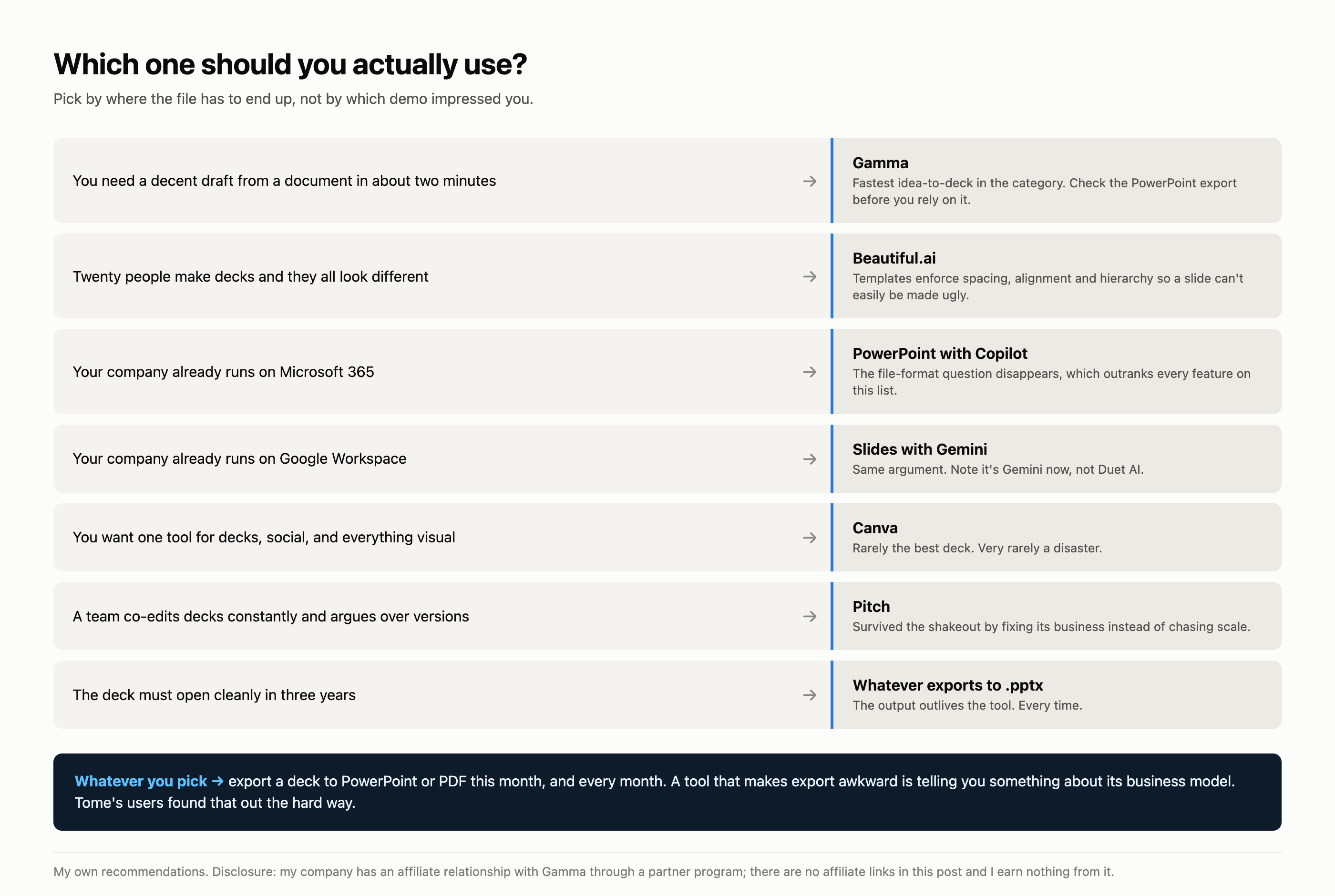
Gamma is the one most people mean when they say AI presentation tool. You give it a prompt or a document and it produces something coherent fast, in a scrolling card format that also works as a webpage. Free tier with credits, Plus around $8 a month billed annually, Pro around $15. It added an image generation product, Gamma Imagine, in March 2026. Its weakness is that its native format is not really a slide deck, so PowerPoint export can need cleanup.
Beautiful.ai is the design engine rather than the language model. Its templates enforce spacing, alignment and hierarchy so that a slide cannot easily be made ugly. Around $12 a month for an individual, roughly $40 per user per month for teams with shared brand controls. Choose it when consistency across a team matters more than speed for one person.
Canva is the pragmatic answer for most organizations, and it is boring in the way that infrastructure should be boring. It has AI features, an enormous asset library, everyone already knows it, and Pro is around $12 a month billed annually. It rarely produces the best deck. It very rarely produces a disaster.
PowerPoint with Copilot is what you should look at first if your company is already on Microsoft 365, purely because the file format question disappears. Your output is a .pptx that everyone can open, edit, and will still be able to open in ten years.
Google Slides with Gemini is the same argument for Google Workspace companies. Note the name: the Duet AI branding that older articles use was retired in February 2024 when Google folded those features into Gemini. If a guide is still calling it Duet AI, that tells you when it was really written.
Pitch deserves a mention because it survived the shakeout by fixing its business rather than chasing scale. After restructuring in January 2024 it runs profitably. Strong on collaboration and version control for teams that live in decks.
Side by side
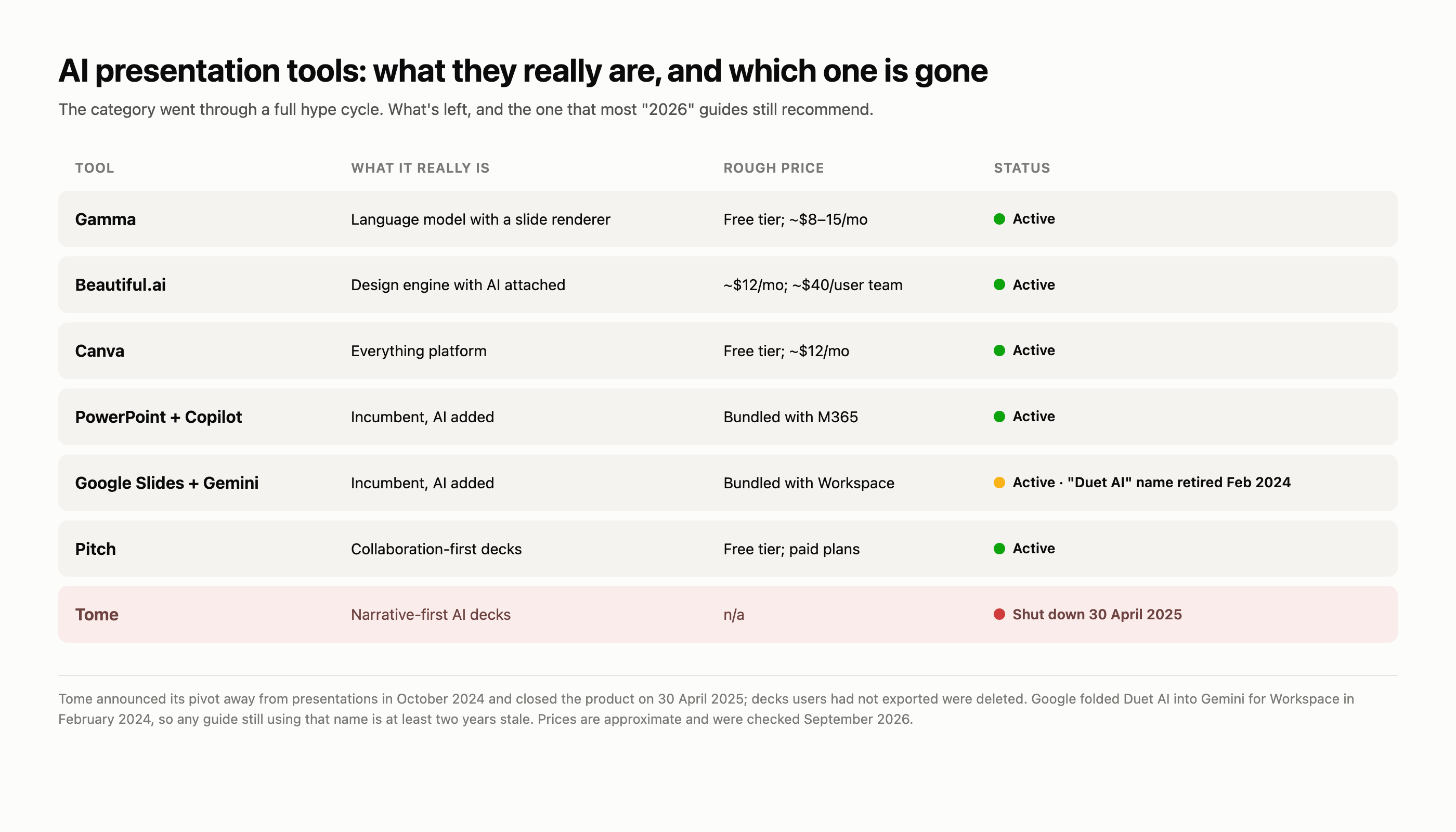
| Tool | What it really is | Rough price | Best when |
|---|---|---|---|
| Gamma | Language model with a renderer | Free tier; ~$8-15/mo | You want a good draft in two minutes |
| Beautiful.ai | Design engine with AI | ~$12/mo; ~$40/user team | Team consistency matters most |
| Canva | Everything platform | Free tier; ~$12/mo | You want one tool for all visual work |
| PowerPoint + Copilot | Incumbent with AI added | Bundled with M365 | You’re already Microsoft and need .pptx |
| Google Slides + Gemini | Incumbent with AI added | Bundled with Workspace | You’re already Google |
| Pitch | Collaboration-first decks | Free tier; paid plans | Teams co-editing decks constantly |
| Tome | n/a | n/a | Discontinued 30 April 2025 |
How to tell a stale guide from a current one
This applies well beyond presentation software, so it’s worth spelling out. I use four tells, and they take about thirty seconds.
Does it recommend something that no longer exists? Tome is the giveaway in this category. In AI video it’s Sora. In agent frameworks it’s AutoGen and TaskWeaver. Every category has one, and the presence of a dead product means the article was assembled from other articles rather than from use.
Does it use retired brand names? “Duet AI” was folded into Gemini in February 2024. Anything still using that name is at minimum two years behind, no matter what year is in the title. Product names are a reliable timestamp because writers copy them without checking.
Are the numbers suspiciously round and uncited? “Reduces deck creation time by 73 percent” is the kind of figure that appears in these articles attached to no study anybody can find. If a statistic has no source you can click, assume it was invented, because quite often it was.
Does it include quotes from experts you cannot find? This is the one I’d flag hardest. A named person at a recognizable company, saying something conveniently supportive, who returns no search results. I’ve found these in articles across this whole category, and once you start looking you cannot stop seeing them.
None of this requires expertise. It requires clicking two links, which is roughly two more than most published roundups have done.
What I’d tell a client
Pick for the file format, not the demo. The output of this work outlives the tool that made it. If your deck has to be opened by a client, a regulator, or a colleague in three years, the format question outranks every feature on the list.
Let the AI do the first draft and nothing else. These tools are genuinely good at getting you from an empty page to a rough structure, which is the part people procrastinate over. They are not good at judgment about what matters to your specific audience. The draft is scaffolding.
Watch what happens to your brand. The fastest way to make a company look sloppy is fifty employees generating decks with fifty different visual identities. If you’re deploying this across a team, the brand controls are the feature that matters, and they’re usually on the more expensive tier.
Do not put anything confidential into a free tier without reading what the vendor does with it. This is the question I get asked least and should be asked most.
The pattern underneath
The same thing happened here that happened in AI video and in agent frameworks, which I’ve written about recently. A category filled up with well-funded products, most of them wrapping the same underlying models, and then it thinned out. The survivors were not the ones with the best demos. They were the ones attached to a business that worked: an incumbent with distribution, or a company charging enough money to exist.
When you’re choosing AI tooling right now, that’s the filter I’d apply before any feature comparison. Not “is this impressive” but “why does this company make money, and will it still be making money when I need this file?”
Sources
- Tome discontinuation and pivot, including the 30 April 2025 shutdown: deckary.com/blog/tome-review
- Tome shutdown timeline and alternatives: ivern.ai/blog/tome-ai-alternative-shut-down-2026
- Google’s Duet AI features folded into Gemini for Workspace, February 2024: workspaceupdates.googleblog.com
- Gemini for Workspace rebrand coverage: 9to5google.com
- Gamma pricing and Gamma Imagine: gamma.app
- Beautiful.ai: beautiful.ai
- Canva pricing: canva.com
- Pitch: pitch.com
- Zapier’s roundup, useful as a cross-check: zapier.com/blog/best-ai-presentation-maker
Pricing in this category changes constantly and every figure above is approximate and was checked in September 2026. Confirm on the vendor’s own page before you buy anything.
Disclosures, since this post recommends products. My company has an affiliate relationship with Gamma through a partner program. There are no affiliate links anywhere in this post and I earn nothing from it. I have no commercial relationship with any of the other tools named.
A note on how this gets made: I run my own content pipeline, the same kind of system I build for clients. It drafts, I edit and fact-check every line, and I sign it. Claiming expertise in production AI and then hiding that I use it would be a strange way to make the point.
— Juan

